
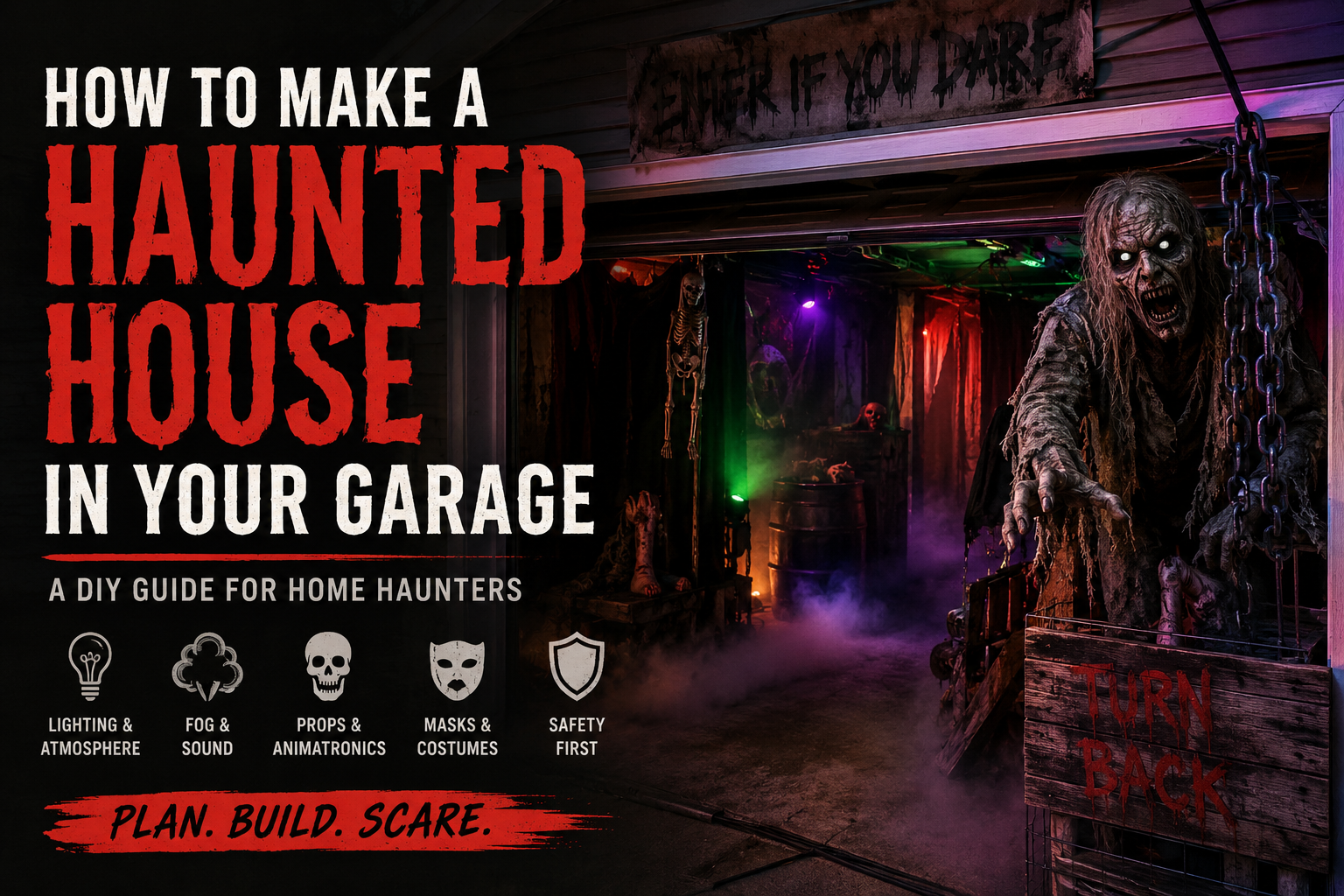
A DIY Guide for Home Haunters
The first garage haunt I ever built was a disaster, and I mean that with affection. Too many lights, a fog machine I didn’t know how to use, and a layout you could see straight through from the driveway. Nobody jumped. But I was hooked, and a few seasons later, that same garage had kids refusing to go in without holding a buddy’s hand.
That’s the thing about figuring out how to make a haunted house in your garage. It looks like it takes a huge budget or a pro’s skill set, but really it comes down to a plan, a dark room, and committing to the bit harder than feels reasonable. Here’s how I’d build it if I were starting over.
Start With a Plan and a Theme
Before you spend a dollar on props, figure out what kind of fear you’re going for. The mistake I made early on was buying cool stuff first and trying to make it fit together later. It never does. A clown room, a zombie outbreak, a rotted-out asylum, a backwoods slaughterhouse, pick one and let everything serve it.
A single committed theme scares people more than a pile of random spooky stuff, every time. One well-dressed clown corner beats a clown, a pirate, and a lonely plastic skeleton sharing a wall. Grab some paper and sketch your garage, then draw the route people will walk: where they come in, how they move through, where they get out. Most garages turn into a decent maze with a simple zig-zag built from hanging sheets, and that twist in the path matters more than you’d think, because people can’t brace for what they can’t see.
Decide now whether you’re using live actors, going all-props, or mixing both. That call drives everything after it.
Prep the Space: Darkness Is Your Best Tool
If you do one thing, kill the light. Daylight leaking under the garage door wrecks the whole effect, so cover every window and that bottom gap with black plastic, cardboard, anything that blocks it out. You want to own what people see and what they don’t.
Then cover the walls. Black plastic sheeting is cheap and basically disappears in low light, which is exactly what you want. If you’d rather go grimy, tattered fabric or cardboard, you’ve painted up to look like rotting walls does the job. Get the ceiling too if you’ve got the energy for it. A low, sagging ceiling makes a room feel wrong in a way people can’t quite name.
Build the path so nobody ever sees the whole room at once. Hanging sheets, cheap frames, stacked boxes, whatever you’ve got. The dread of the next corner does half your work for you.
Lighting and Atmosphere
Once it’s dark, you decide what gets seen. Kill the white overhead light first thing. It flattens everything and shows every seam. Low, colored light coming from the floor or the side throws long shadows and keeps your scares hidden until the second you want them found.
Green and deep red just feel wrong to people, in the best way. Blue goes cold and dead. Drop a single strobe in one key spot and a still prop suddenly looks like it’s twitching toward you. I like leaving real pockets of pitch-black between the lit areas because the dark stretches are where people’s imaginations do the heavy lifting. The haunted house lighting and special effects gear at The Horror Dome has the strobes and effect lighting if you don’t already have a stash.
Light what scares them. Hide the rest.
Fog, Sound, and Special Effects
Fog is the quickest way to make a garage stop feeling like a garage. Low fog rolling across the floor hides your cords, softens the walls, and makes every beam of light show up in the air. A basic fogger changes a room on its own, and if you add a chiller, the fog stays low and creeping instead of drifting up to the ceiling. The fog machines here cover most garage-sized spaces.
Don’t sleep on sound, either. A loop of far-off screams, dripping water, a low hum, or a chainsaw coughing to life in the dark fills the quiet and covers the clicks and whirs of your props as they give themselves away. I run one speaker by the entrance, and one buried deeper in, so the noise chases people through. A loud sound landing at the same beat as a visual scare is the combo that gets the real screams.
Props and Animatronics: Your Centerpiece Scares
You need a few big moments, the ones people are still talking about in the driveway afterward. That’s what props and animatronics are for. A motion-triggered animatronic that drops or lunges as someone rounds the corner hits every single time, and it never gets tired or breaks character. The animatronics at The Horror Dome run from budget pieces up to the serious professional stuff you can build a whole room around.
Around those big hits, fill the space with static props. A body slumped in a corner, a severed hand, something hanging where people don’t expect it. The haunted house props are made to take a beating, which matters once a few hundred people have brushed past them in one night. Put your best, goriest pieces where the light catches them and leave the rest half-hidden. What people barely see scares them more than what’s lit up clear as day.
Masks and Costumes for Live Scare Actors
Nothing rattles people like another human, and one good scare actor can carry a whole garage on their own. If you’re going that way, spend the money on a real mask and a full costume. I’ve watched a fantastic setup fall apart the second somebody clocked a five-dollar mask over a hoodie.
A solid latex or silicone mask still reads as real up close, even in dim light, whereas cheap ones give themselves away instantly. Pair it with a full costume so there’s no gap between the face and the rest of the body. The masks and costumes at The Horror Dome are built for actual haunt actors, so they hold up to a whole night of work instead of falling apart by 9 p.m.
The other thing I drill into anyone acting for me: it’s all about timing. The scare that works isn’t the loud one. It’s the one that waits, lets the group get comfortable, and comes from the side nobody’s watching.
Safety First, Always
None of this is worth it if somebody gets hurt. Keep the whole path clear of anything you can trip on, and make sure the floor’s even. Tape down every cord or run it up out of the way, especially near the foggers and lights.
Be careful with fire. Keep foggers and hot lights away from fabric and anything that’ll catch fire, don’t overload your outlets, and leave the electrical panel reachable.
Most importantly, build in an emergency exit that isn’t part of the maze, because both your guests and your actors need a fast way out if something goes sideways. Keep a fire extinguisher and a flashlight within reach. And if anyone coming through is sensitive to strobes, either skip them or put a clear warning at the door.
Finishing Touches and Budget Tiers
The little stuff is what closes the deal. Cobwebs stretched into the corners, fake blood spattered where it’ll catch the light, a creepy scrawled message on the wall, even a damp, earthy smell in the air. That’s the difference between a garage that’s decorated and one that’s genuinely unsettling.
Roughly, here’s how the spending tends to shake out:
Starter: Black plastic on the walls and windows, one fogger, a few colored bulbs or a single strobe, a soundtrack off a hidden speaker, and a handful of props. You can genuinely creep people out in one room without spending much.
Mid-level: Add an animatronic as your centerpiece, some better props, layered lighting, and one costumed actor in a real mask. This is where most home haunters land, and honestly, it’s the sweet spot.
All-out: Multiple rooms, a few animatronics, full wall and ceiling treatment, several actors in full costume, and lighting and sound that actually work together. This is the one the whole street remembers for years.
Wherever you start, buy stuff that lasts. Almost every home haunt gets a little bigger every year, and good props carry right over to the next season.
Start Planning Now
The haunts that actually land aren’t slapped together the last week of October. They’re planned for months. Pick your theme, sketch your layout, and start pulling together your lights, fog, props, and costumes early, so you’re testing scares in September instead of panicking on the 30th.
Your garage already has everything it needs to be the scariest stop on the block. It’s just waiting on you to commit to the dark. Go build it, and give the neighbors a reason to cross the street.