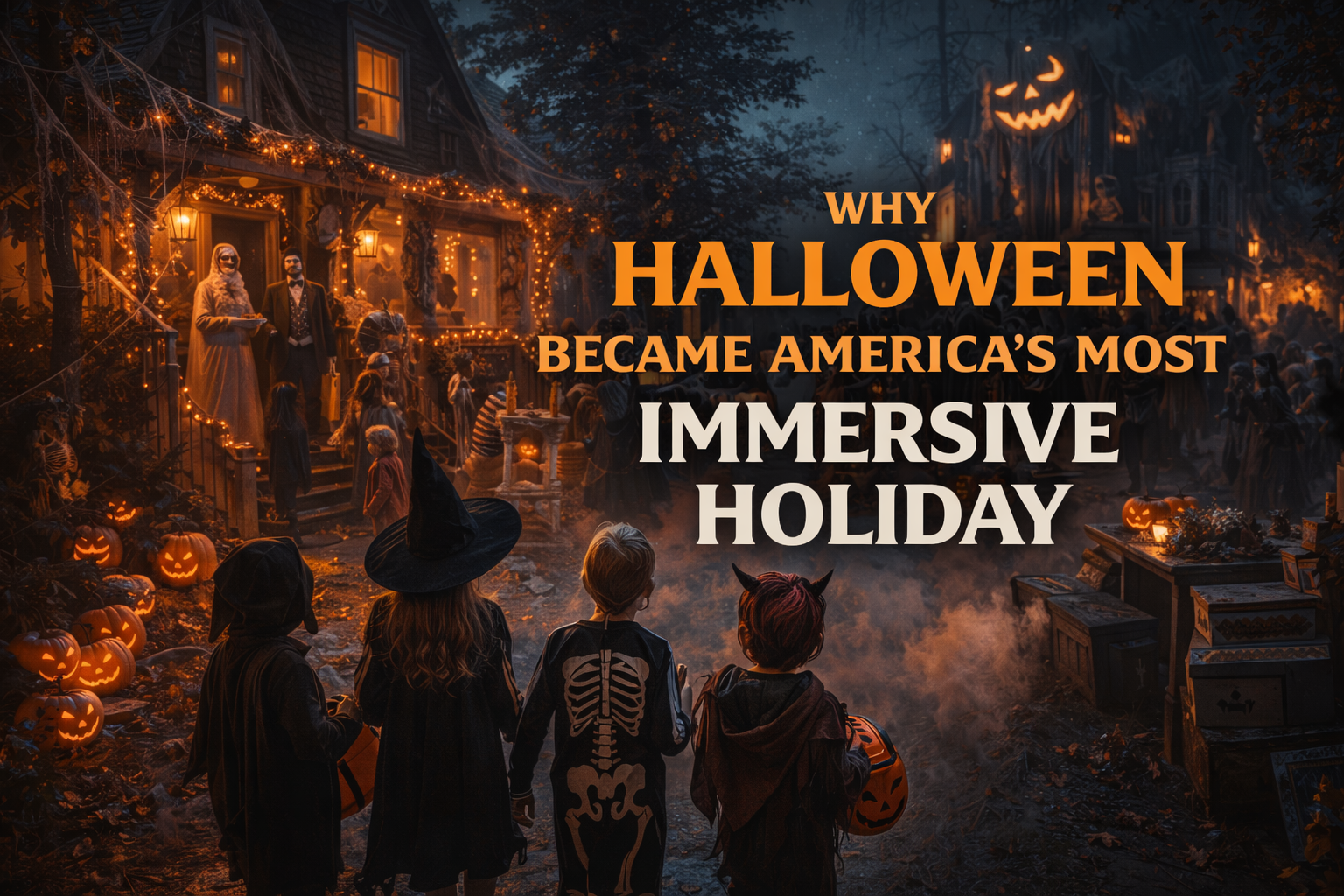
Why Halloween Became America’s Most Immersive Holiday
No other holiday invites participation the way Halloween does.
Christmas is observed.
Independence Day is celebrated.
Thanksgiving is shared.
But Halloween is entered.
It is walked through, worn, built, staged, and performed. It transforms neighborhoods, storefronts, theaters, and entire attractions into immersive environments.
Over the past century, Halloween has evolved from a night of costumes and candy into the most immersive cultural event in America.
From Harvest Ritual to Cultural Phenomenon
Halloween’s roots stretch back centuries to harvest festivals and traditions centered on the thinning veil between worlds.
But modern Halloween, the version recognized today — began reshaping itself in early 20th-century America.
It shifted from:
-
Superstitious observance
-
Community pranks
-
Informal gatherings
Into:
-
Structured celebrations
-
Organized parades
-
Decorated neighborhoods
What began as folklore slowly became theatrical.
The Rise of Costumes and Identity Play
One of the defining elements of Halloween culture is transformation.
Costumes allow individuals to:
-
Step outside daily identity
-
Explore archetypes
-
Embody fear
-
Play with power dynamics
Over time, costume craftsmanship evolved from homemade sheets and masks into high-detail, professional-grade creations.
The growth of cosplay, silicone mask realism, and character immersion has deepened Halloween’s cultural footprint.
Halloween is no longer simply about disguise.
It is about embodiment.
Haunted Houses and the Birth of Public Immersion
As Halloween matured, haunted attractions became a central feature of the season.
Community haunts evolved into commercial experiences. What once existed as simple walkthroughs became elaborate productions.
These attractions introduced:
-
Environmental storytelling
-
Coordinated lighting systems
-
Animatronic integration
-
Actor choreography
-
Thematic continuity
Halloween stopped being decorative.
It became experiential.
The Influence of Film and Media
Horror cinema significantly shaped modern Halloween culture.
From classic monster films to contemporary psychological thrillers, horror storytelling influenced:
-
Costume trends
-
Haunted attraction themes
-
Decorative styles
-
Audience expectations
Streaming platforms further accelerated this shift.
Audiences now arrive at haunted attractions having consumed high-production horror narratives. The standard has risen accordingly.
Halloween reflects the horror culture surrounding it.
Social Media and Shareable Fear
Modern Halloween thrives in a digital world.
Neighborhood displays compete for online attention. Haunted attractions market immersive scenes designed for shareable moments.
This visibility encourages:
-
Higher design standards
-
Increased realism
-
Expanded creativity
-
Stronger branding
Halloween is no longer a one-night event. It is documented, distributed, and discussed.
The culture sustains itself beyond October 31.
Why Immersion Defines Halloween
Unlike most holidays, Halloween demands physical participation.
It engages:
-
Visual design
-
Sound environments
-
Textural detail
-
Narrative imagination
-
Emotional tension
Immersion is the core experience.
Guests walk through haunted attractions. Children move door to door in costume. Entire neighborhoods become theatrical sets.
Halloween does not simply decorate space.
It transforms space.
The Professionalization of Halloween Culture
As immersive standards increased, so did professionalization.
Today, Halloween includes:
-
Professional haunt operators
-
Special effects artists
-
Mask sculptors
-
Scenic fabricators
-
Event producers
Entire industries revolve around delivering immersive fear.
Halloween culture has matured into a serious creative discipline.
A Holiday Built on Participation
What makes Halloween unique is not just its aesthetics.
It is its interactivity.
Every participant becomes part of the spectacle:
-
The homeowner decorating a yard
-
The actor inside a haunt
-
The designer building sets
-
The guest navigating darkness
Halloween blurs the line between observer and performer.
That is immersion at scale.
Why Halloween Continues to Expand
Several factors ensure Halloween’s continued growth:
-
Expanding horror media
-
Increased appetite for immersive experiences
-
Community-level creativity
-
Commercial innovation
-
Year-round haunt events
Halloween is no longer a single night.
It is a season.
For some, it is a profession.
Frequently Asked Questions
Why is Halloween considered immersive?
Halloween transforms physical environments and invites participation through costumes, haunted attractions, and interactive experiences.
How did haunted houses influence Halloween culture?
Haunted attractions elevated Halloween from decorative celebration to immersive, narrative-driven entertainment.
Why has Halloween grown in popularity?
Film, media, social sharing, and immersive design innovations have expanded Halloween’s cultural reach.
Is Halloween becoming more professional?
Yes. The growth of commercial haunted attractions, special effects artistry, and immersive design has professionalized the season.
Halloween became America’s most immersive holiday not because it grew louder or more decorated.
It became immersive because it invited participation.
It turned neighborhoods into stages.
It turned fear into craft.
It turned October into an experience.
And it continues to evolve.