
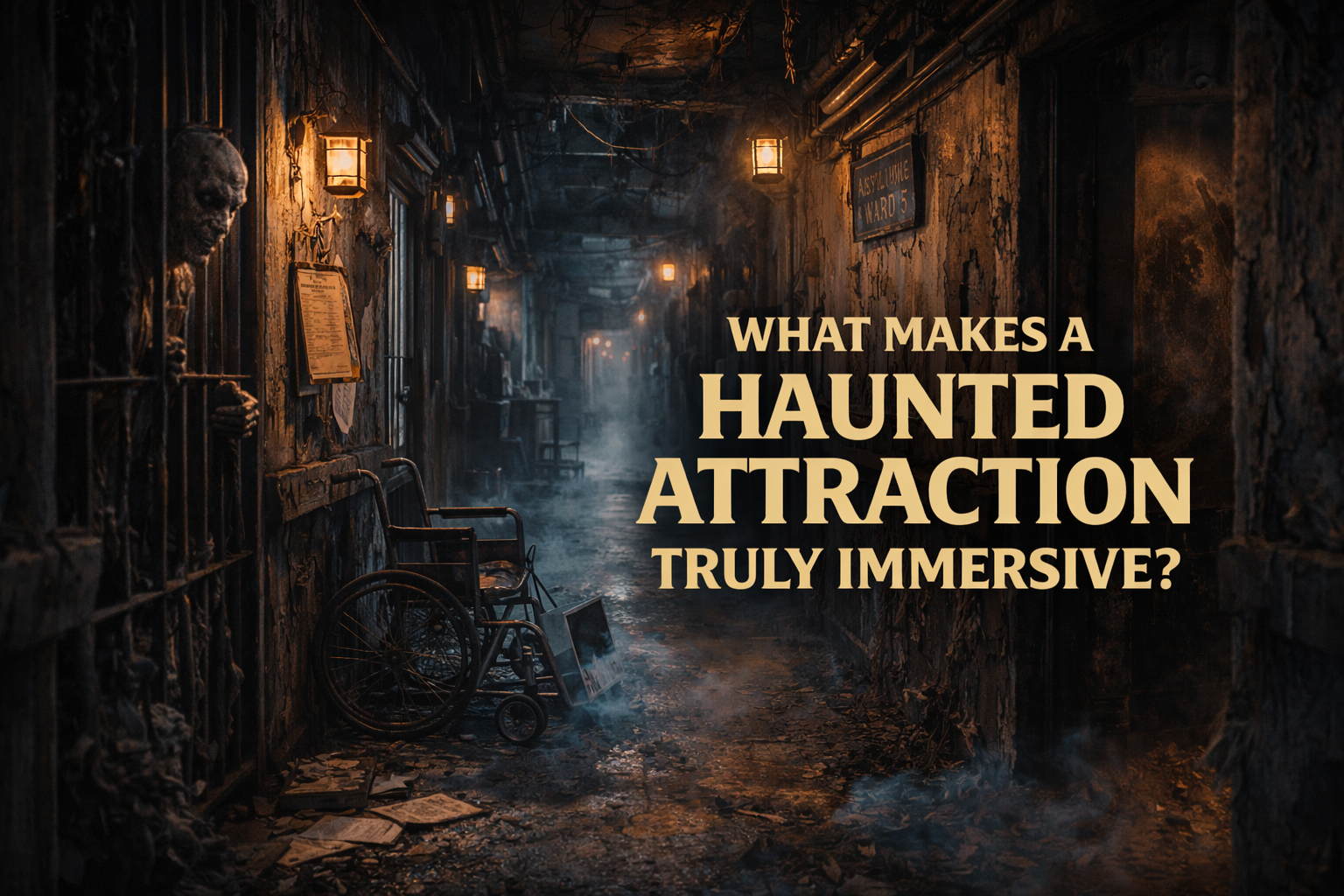
What Makes a Haunted Attraction Truly Immersive?
Not every haunted attraction is immersive.
Some rely on noise. Others depend on darkness. Many lean heavily on isolated jump scares. While those elements can startle, they do not necessarily create immersion.
A truly immersive haunted attraction does something different: it makes guests forget they are walking through a constructed space.
Immersion is not louder.
It is deeper.
What Is an Immersive Haunted Attraction?
An immersive haunted attraction is a designed horror environment where storytelling, environmental detail, lighting, sound, mechanical effects, and actor performance work together to create a cohesive, believable world.
In immersive haunt design:
-
Every room connects narratively.
-
Every scare has context.
-
Every effect supports atmosphere.
-
Every transition feels intentional.
Immersion replaces randomness with structure.
Environmental Storytelling: Building a Believable World
Immersion begins with environment.
A haunted attraction that feels immersive does not rely on isolated themed rooms. Instead, it builds a cohesive world.
Environmental storytelling includes:
-
Consistent architectural style
-
Layered scenic detail
-
Realistic prop placement
-
Logical environmental decay
-
Visual continuity between scenes
For example, an abandoned hospital theme should not suddenly shift to a medieval dungeon without narrative explanation.
Design cohesion anchors immersion.
Guests may not consciously notice the continuity, but they feel it.
Lighting and Sound as Psychological Tools
Lighting and sound design are often underestimated.
In immersive haunted attractions, lighting does more than illuminate. It shapes perception.
Consider:
-
Directional lighting to control sightlines
-
Color temperature shifts to change emotional tone
-
Controlled shadow placement to suggest unseen movement
Sound design is equally powerful:
-
Layered ambient noise
-
Directional audio cues
-
Controlled silence
-
Environmental hum or vibration
Immersion requires sensory layering. Jump scares without atmospheric foundation feel disconnected.
Scare Timing and Pacing
Immersion depends on pacing.
Constant high-intensity scares reduce tension. Guests become numb.
Immersive haunted attractions use:
-
Slow tension build-up
-
Environmental discomfort
-
Controlled anticipation
-
Strategic scare placement
The best scares are rarely the loudest. They are the ones that arrive after suspense has been carefully constructed.
Scare timing must align with guest flow, lighting transitions, and environmental cues.
Precision replaces chaos.
The Role of Animatronics in Immersion
Animatronics are powerful immersion tools when used strategically.
In immersive haunted attractions, animatronics:
-
Anchor scenes
-
Deliver repeatable timing
-
Support narrative elements
-
Integrate with lighting and audio
However, animatronics alone do not create immersion.
A high-end mechanical effect placed in a poorly designed environment feels isolated.
When integrated correctly, animatronics enhance realism by:
-
Reinforcing environmental storytelling
-
Delivering consistent movement cues
-
Creating believable physical presence
Motion must feel natural. Reset timing must remain invisible to guests.
Mechanical precision supports immersive illusion.
Actor Performance and Scene Choreography
Actors remain essential in immersive haunt design.
But immersive performance differs from simple jump scares.
Professional haunt actors are trained to:
-
Maintain character consistently
-
Read guest reactions
-
Control distance and engagement
-
Coordinate with mechanical cues
-
Reset quietly between groups
Scene choreography matters.
An actor positioned poorly can break immersion by exposing mechanics or revealing transitions.
In immersive haunted attractions, actors enhance atmosphere rather than dominate it.
Psychological Tension vs Surface-Level Shock
Surface-level shock relies on noise and sudden movement.
Psychological immersion relies on discomfort and uncertainty.
Immersive haunted attractions use:
-
Narrow passageways
-
Uneven floor textures
-
Controlled claustrophobic moments
-
Subtle environmental movement
-
Suggestion rather than explicit reveal
The mind often creates stronger fear than any mechanical effect.
Immersion taps into anticipation rather than repetition.
Throughput and Guest Flow
Immersion cannot collapse under operational pressure.
Haunted attraction design must account for:
-
Reset timing
-
Group spacing
-
Transition flow
-
Emergency exit planning
-
Actor endurance
If scenes bottleneck or reset timing becomes visible, immersion breaks.
Professional haunted attractions treat flow as part of design — not an afterthought.
Throughput efficiency protects both safety and experience quality.
,,sign Cohesion Across the Entire Attraction
Immersive haunted attractions maintain consistency from entry to exit.
This includes:
-
Exterior facade alignment with interior themes
-
Queue line atmosphere
-
Staff presentation
-
Lighting continuity
-
Sound transitions
Even small inconsistencies, exposed modern objects, mismatched props, visible control panels, can weaken immersion.
Design discipline sustains believability.
Why Immersion Matters More Than Ever
Audiences are increasingly sophisticated.
Streaming horror, cinematic special effects, and interactive experiences have elevated expectations.
Guests now look for:
-
Authentic environments
-
Narrative depth
-
Realistic movement
-
Emotional tension
In competitive markets, immersive haunted attractions stand out.
They generate stronger word-of-mouth.
They create repeat attendance.
They build long-term brand credibility.
Immersion is no longer optional.
Frequently Asked Questions
What defines an immersive haunted attraction?
An immersive haunted attraction integrates storytelling, environmental design, lighting, sound, animatronics, and actor performance into a cohesive, believable horror experience.
Are animatronics necessary for immersion?
Not always, but well-integrated animatronics enhance realism and timing precision in immersive haunted environments.
How do haunted attractions improve immersion?
By focusing on narrative cohesion, environmental continuity, sensory layering, and controlled pacing instead of relying solely on jump scares.
Why is pacing important in immersive horror?
Effective pacing builds psychological tension and prevents scare fatigue, sustaining immersion throughout the attraction.
Immersion Is Intentional
A haunted attraction becomes immersive when every element serves the same world.
Scenic design.
Lighting.
Sound.
Mechanical effects.
Actor performance.
Guest flow.
Nothing exists in isolation.
Immersion is not achieved by adding more.
It is achieved by aligning everything.
The most successful haunted attractions are not the loudest or the largest.
They are the most cohesive.
And cohesion is designed.