
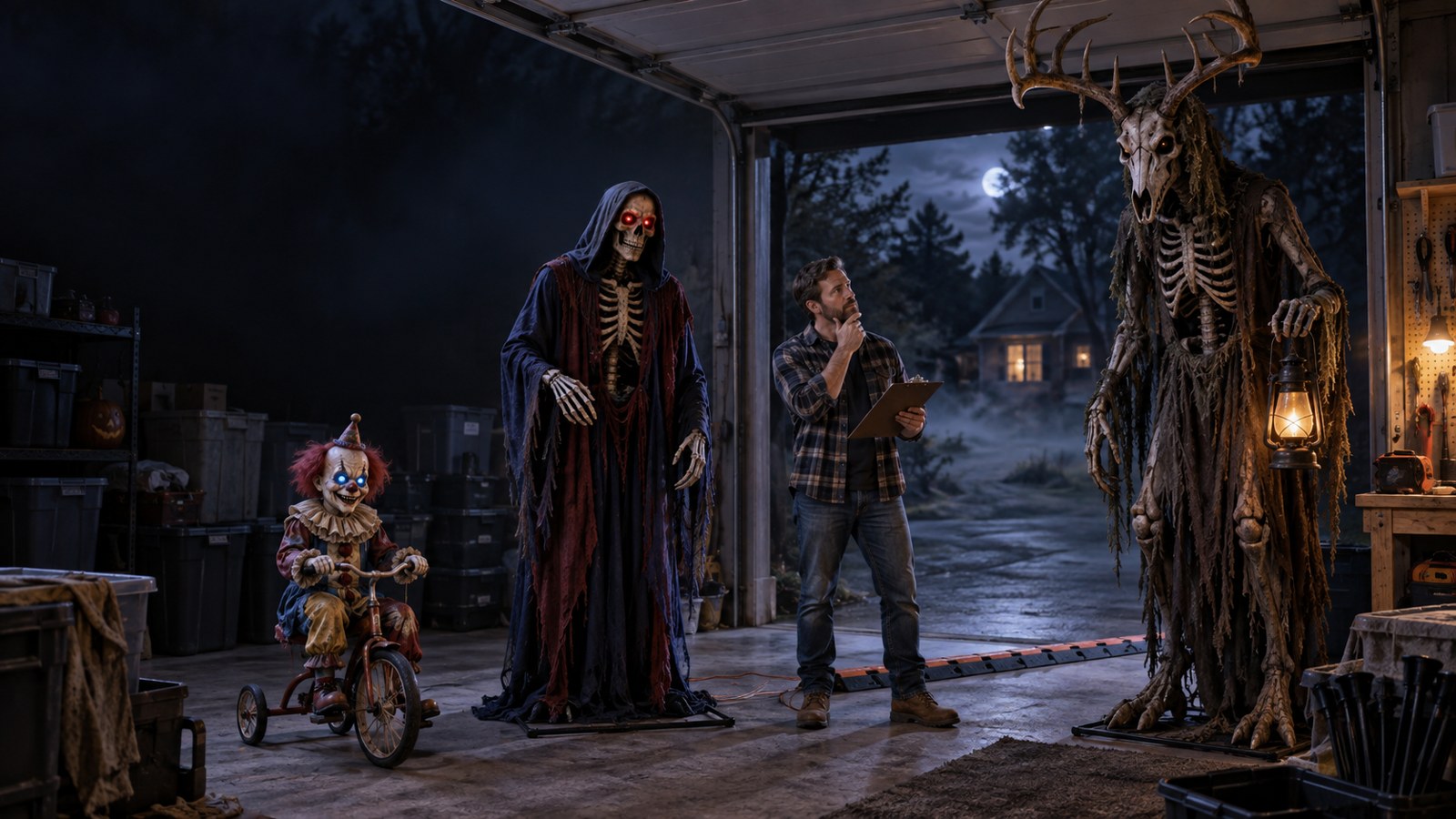
For most first-time buyers, $250 to $500 is a sensible total budget for a Halloween animatronic setup. That usually means spending about $165 to $400 on the animatronic itself and keeping the rest for batteries or protected power, anchoring, lighting, weather protection, and storage.
If you are decorating a small indoor room, you may be happy closer to $150 to $250. If you want a life-size outdoor centerpiece, expect the complete setup to land closer to $350 to $600. Professional haunted-attraction animatronics can cost thousands, but they are rarely the right first purchase for a home haunter.
The best first animatronic is not simply the biggest one you can afford. It is the one that fits your space, survives your conditions, works with your theme, and can be stored without becoming a year-round problem.
The short answer: choose the scene before the price
Before you set a dollar limit, decide what job the animatronic must perform.
Do you need a small moving detail that rewards guests who look closely? A life-size character that anchors a porch? A tall silhouette visible from the street? A sudden motion scare inside a garage walkthrough?
Those are different jobs, and they call for different budgets.
| First-time use | Sensible prop price | Likely total setup budget | Best for |
|---|---|---|---|
| Small indoor accent | $100–$200 | $150–$250 | Tabletops, windows, covered rooms, compact carnival scenes |
| Life-size starter centerpiece | $200–$300 | $275–$425 | Porches, garage haunts, entry scenes, graveyards |
| Large statement animatronic | $300–$500 | $400–$650 | Tall outdoor displays, wide viewing distances, major focal points |
| Professional attraction prop | $1,000 and up | $1,250 and up | Ticketed haunts with trained staff, controlled installation, maintenance plans |
The middle two rows are the sweet spot for most beginners. They provide enough height, movement, sound, and visual presence to feel like a real upgrade without demanding professional infrastructure.
You can compare the current selection in The Horror Dome’s Halloween Animatronics collection. Product examples were originally checked on September 15, 2026. Mother’s price was updated on October 4, 2026; prices and availability may change.
What do you actually get at each price level?
Price often tracks size and complexity, but not always scare value. A small prop in the perfect location can outperform a much more expensive character placed in an empty yard.
Under $200: compact movement and a focused theme
The under-$200 tier is a good entry point when space is limited or when you want to test whether animatronics fit your decorating style.
For example, The Horror Dome’s Tricycle Clown Doll Electric Animated Halloween Animatronic was listed at $164.99 when this article was prepared. The 32-inch clown has glowing eyes, sound, and back-and-forth movement, and it runs on four AA batteries.
That kind of prop can work well in a covered carnival scene, at the end of a hallway, or behind a dirty window. It does not need to dominate the yard. Its strength is that the movement feels strange and specific.
This tier is best when:
- Your display is indoors or fully covered.
- You have limited storage space.
- You already own lighting and scene dressing.
- You want one controlled effect instead of a towering figure.
- You would rather spend part of the budget on a high-quality mask and a live actor.
That last option matters. The Horror Dome is especially strong in Halloween masks, and a convincing mask worn by a well-hidden actor can create a more adaptable scare than an inexpensive animatronic alone. A compact animated prop can attract attention while the actor delivers the surprise.
$200 to $300: the best first-time range for many buyers
This range often offers the best balance of size, motion, and manageable setup.
The Rising Skeleton Reaper in Hooded Cloak, listed at $249.99, is a useful example. It stands more than six feet tall, has light-up eyes, and rises when motion activated. That gives it three things a first purchase needs: a readable silhouette, an obvious action, and a clear place in a scene.
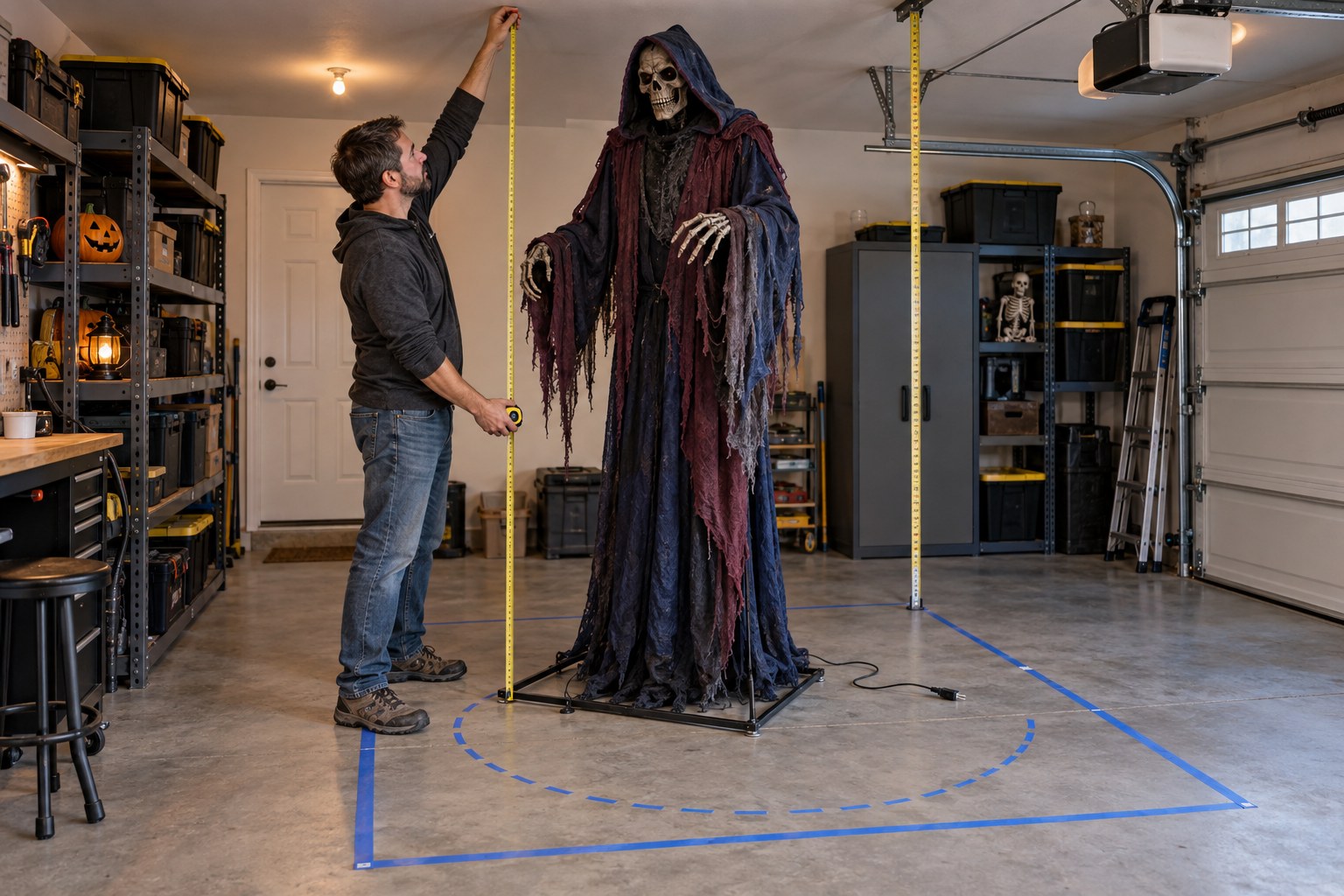
It also shows why you should read dimensions instead of relying on product photos. At roughly 81.5 inches tall, the reaper needs enough overhead clearance when fully raised. Its base and activation area also need space that guests cannot enter.
Choose this tier if you want:
- One recognizable centerpiece for a graveyard, porch, or garage.
- A prop that is large enough to read from several yards away.
- Motion activation without the cost of professional control equipment.
- A purchase that can move into a new theme next year.
A reaper, skeleton, witch, or clown is usually more reusable than a highly specific licensed character. Versatility adds value over several seasons.
$300 to $500: more scale, detail, and visual authority
Moving into the $300-to-$500 range can make sense when the animatronic must carry a large scene.
The Skeleton Forest Creature with Horns was listed at $399.99. It is approximately 98 inches tall and 48 inches wide, with a lantern, animated movement, and spoken phrases. In a woodland, cryptid, or cursed-forest display, its height and antlered silhouette can become the visual reason people stop.
But a larger prop creates larger obligations. You need to consider wind, level ground, overhead branches, pathways, neighboring props, and an eight-foot-tall storage problem after Halloween.
Spend at this level when:
- The animatronic will be the clear focal point.
- You have measured the display and storage areas.
- You can anchor it according to the manufacturer’s instructions.
- You can protect it from rain, wind, and tampering.
- The theme will return for more than one season.
If none of those statements is true, a $250 prop with better lighting and scenery may produce a stronger result.
$1,000 and up: professional equipment, professional obligations
The Horror Dome also sells commercial-scale pieces such as the made-to-order Mother Life-Size Professional Halloween Animatronic, listed at $4,299.99. The product page notes a six-to-eight-week production time, with possible peak-season delays.
This is not a typical beginner purchase. It is an example of how different the professional tier becomes.
Attraction-grade props may require a controlled environment, staff training, scheduled inspections, replacement parts, specialized shipping, longer lead times, and a plan for guest separation. The purchase price is only the start.
For a home display, do not assume that spending ten times more will create ten times the reaction. Professional pieces make sense when the attraction has the traffic, operations, and revenue to support them.
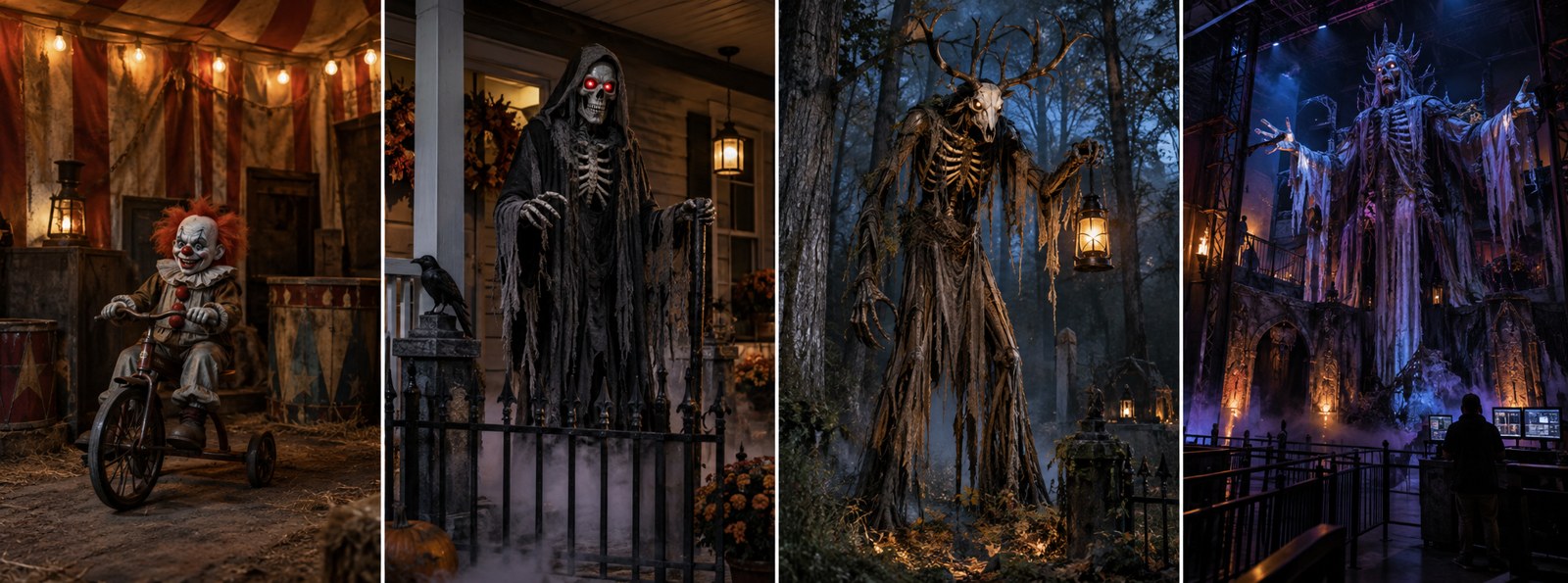
Budget for the complete scare, not just the character
The number on the product page is not your final cost. A first animatronic often needs supporting items before it is ready for guests.
Use this simple planning rule:
Reserve 20% to 30% of your total budget for setup, protection, and presentation.
If your total budget is $400, aim for a prop near $280 to $320. That leaves $80 to $120 for the things that make it safer and more convincing.
Power and batteries
Some animatronics plug into household power; others use batteries. Read the product listing and instructions before purchase.
For plug-in units, you may need an outdoor-rated extension cord, a weather-resistant connection cover, and a properly protected outlet. Keep connections off wet ground and follow the manufacturer’s electrical requirements. Never use an indoor-only cord outdoors.
Battery-powered props avoid a cord crossing the scene, but batteries become an operating cost. Keep a spare set available and test the prop before guests arrive. Weak batteries can turn a sharp movement into a slow, unconvincing wobble.
Anchoring and guest separation
Tall props can catch wind like sails. Even a covered porch can experience strong gusts.
Plan for the anchoring method permitted by the manufacturer, and create a physical buffer between moving parts and guests. Landscape stakes, ballast, railings, or scenery may be appropriate depending on the product and surface, but never improvise in a way that strains the frame or blocks its motion.
Motion creates pinch points. Children will reach toward anything that moves. Build the display so guests can enjoy the effect without entering the mechanism’s range.
Lighting
An animatronic should not disappear into darkness, but it should not be flattened by a bright floodlight either.
A small spotlight placed low and off to one side can reveal the face and movement. A dim backlight can separate the silhouette from the background. If the prop has illuminated eyes or internal effects, avoid lighting that overwhelms them.
Good lighting often adds more perceived value than moving from a $250 figure to a $400 figure.
Scene dressing
Give the character a reason to be there.
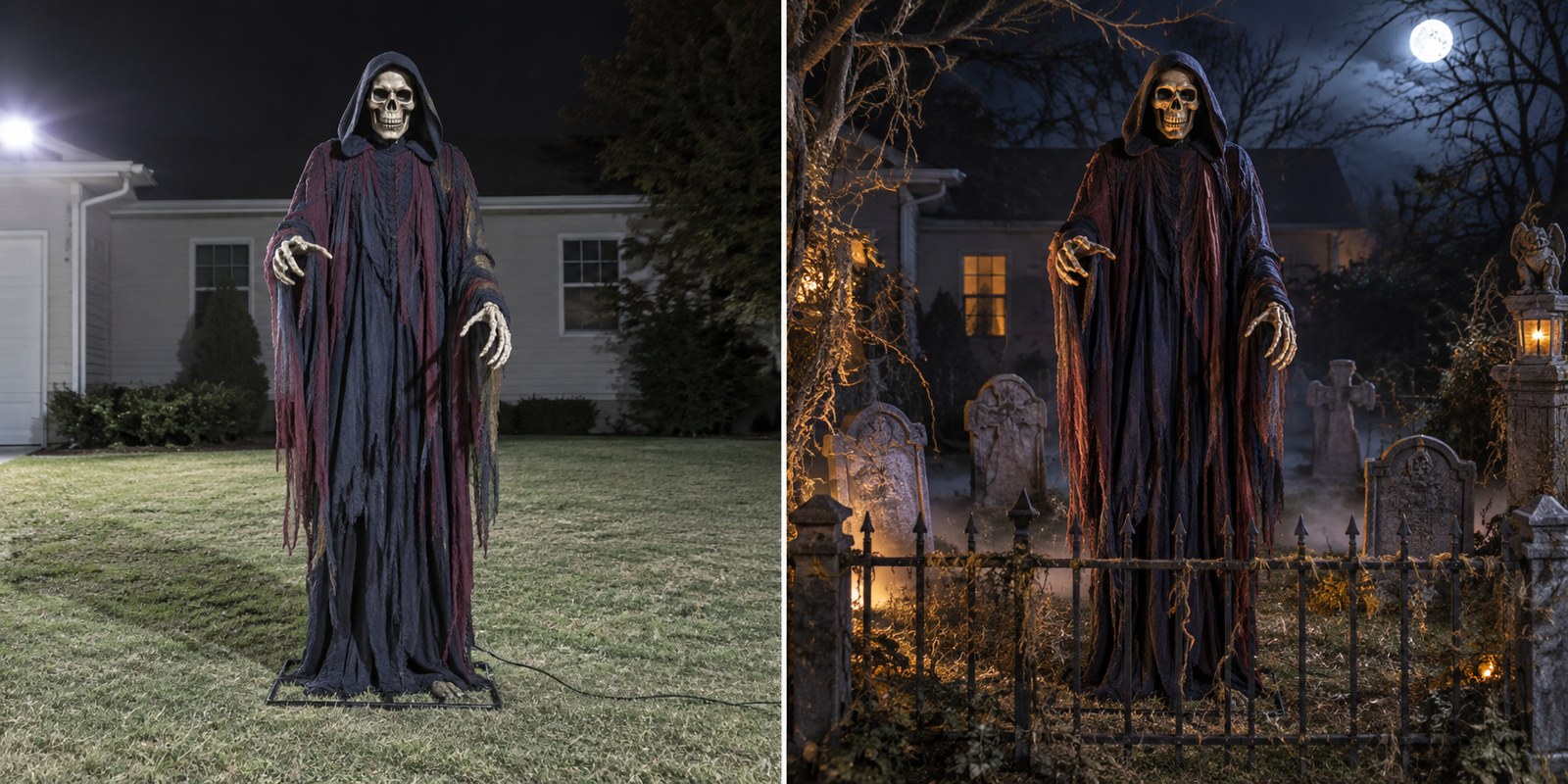
A reaper belongs among tombstones, dead vines, and a broken gate. A tricycle clown needs a piece of abandoned carnival scenery. A forest creature benefits from branches, burlap, moss, and an uneven woodland silhouette.
The scenery does not have to be expensive. Dark fabric, salvaged-looking signs, foam stones, branches, and controlled lighting can make the animatronic feel integrated rather than dropped onto the lawn.
Weather protection
Do not interpret “outdoor display” as permission to expose electronics and fabric to any weather. Check the manufacturer’s instructions and bring the prop inside when conditions exceed its rating.
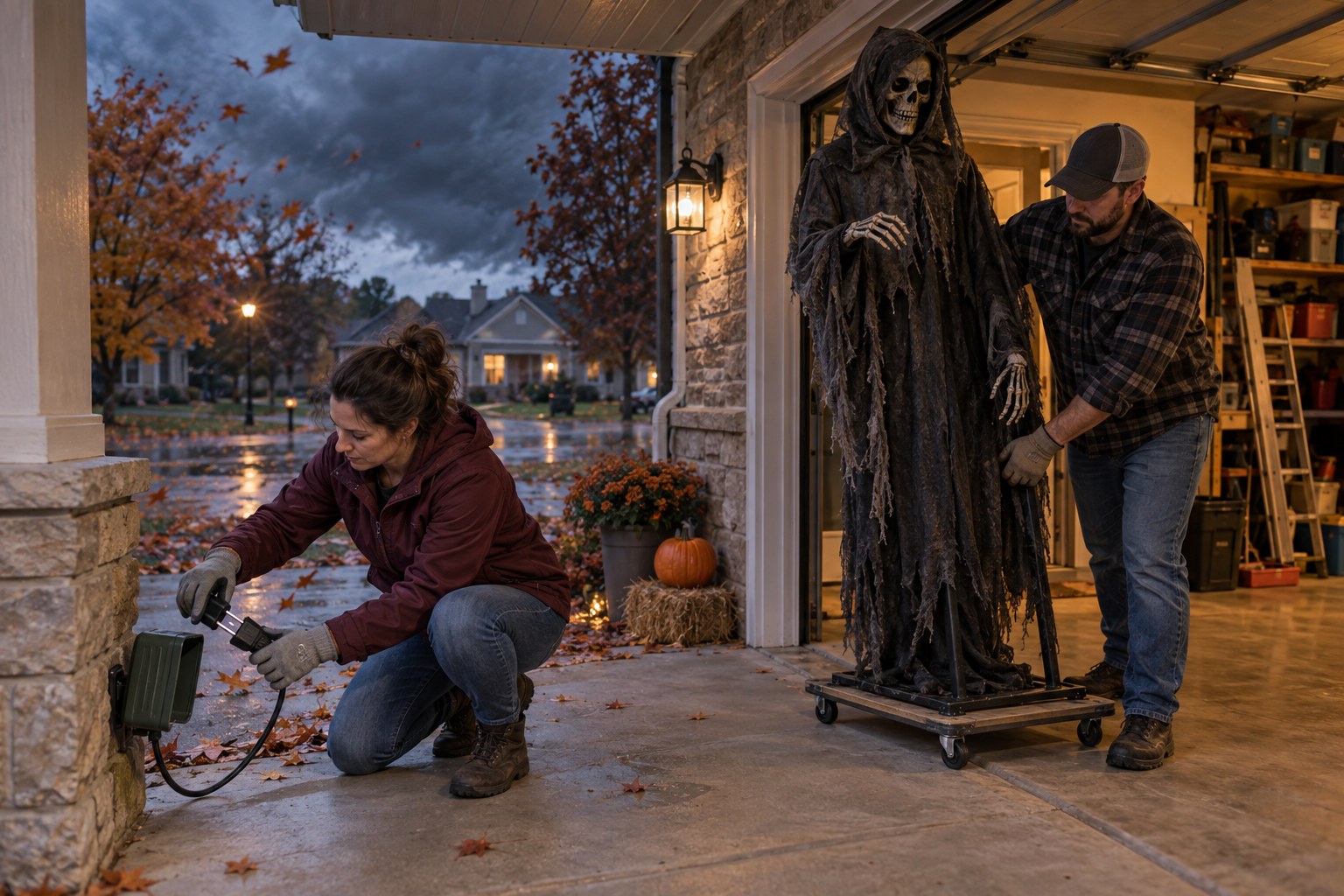
In Lafayette and the rest of Tippecanoe County, October can bring rain, damp evenings, and gusty weather. A homeowner setting up near an open driveway should have a quick shutdown plan and a dry place ready before the forecast turns. If moving the prop takes 20 minutes and two people, practice that process before opening night.
Storage
Storage is the most ignored cost.
Before buying, measure the product box or collapsed frame if those dimensions are available. Decide whether it will live in a basement, garage, attic, shed, or rented storage space. Consider stairs, door widths, moisture, heat, and the risk of crushing delicate parts.
Keep the original packaging when practical. Label hardware bags, photograph cable connections during assembly, and store the instructions with the prop.
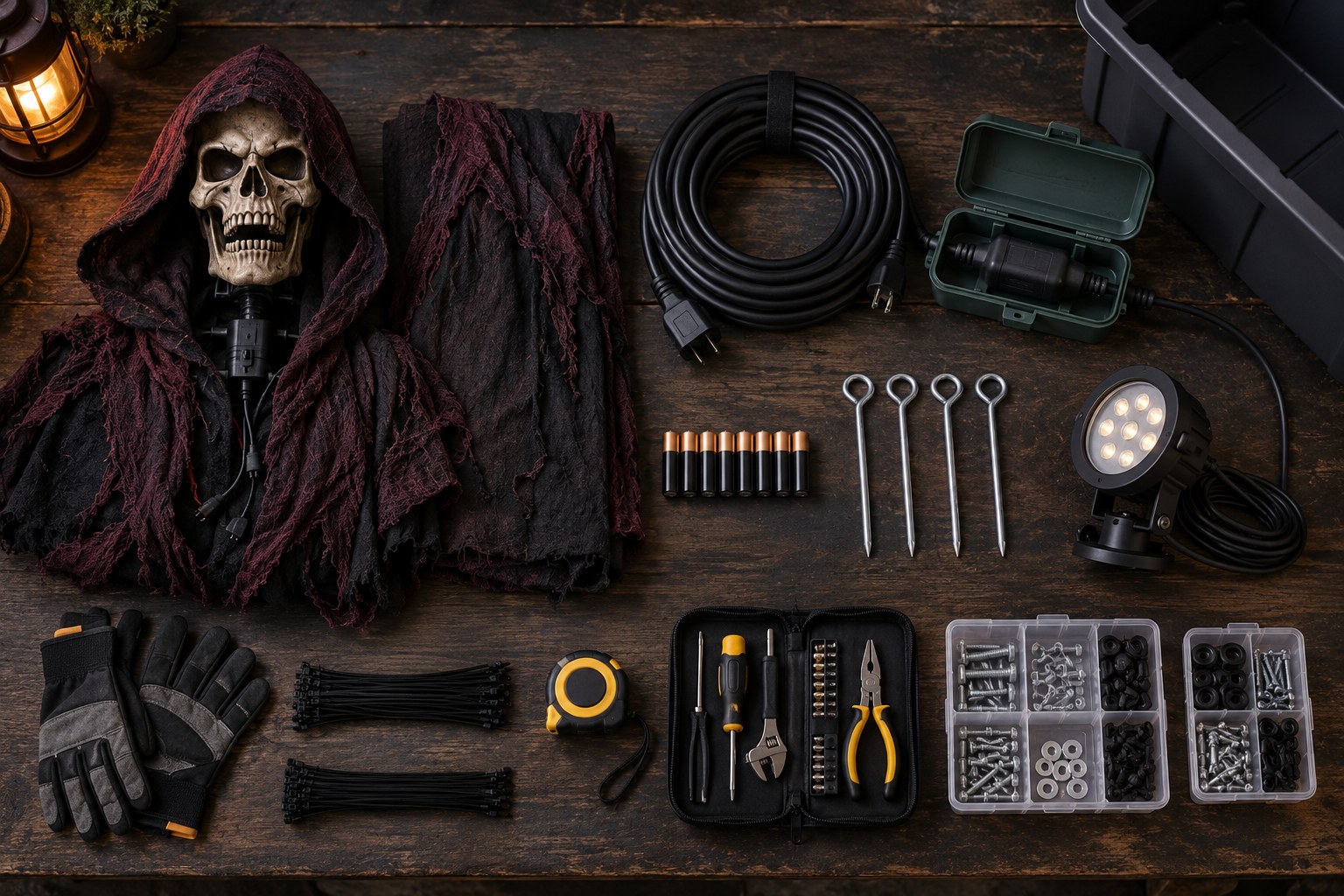
A realistic first-purchase budget
Suppose a Lafayette homeowner has a $400 budget for a covered garage haunt. The display is a graveyard entrance, and the animatronic will run for two October weekends.
A workable budget might look like this:
| Item | Planned amount |
|---|---|
| Life-size animatronic | $250 |
| Protected power or fresh batteries | $30 |
| Anchoring and guest barrier | $45 |
| Focused lighting | $40 |
| Scene dressing and repair supplies | $25 |
| Contingency | $10 |
| Total | $400 |
This buyer does not need the largest creature in the catalog. A $250 rising figure, properly placed behind a short cemetery fence and lit from below, can create a complete moment.
Now imagine the same buyer spends all $400 on the character. The prop arrives, but there is no protected power connection, no barrier, and no light aimed at the face. The figure may be more expensive, yet the scene is weaker and less safe.
Five questions to ask before you buy
1. Where will guests first see it?
Measure the viewing distance. Small detailed props work at close range. Tall silhouettes work from the sidewalk or street.
If guests will first see the animatronic from 40 feet away, subtle hand movement may not matter. If they will pass within six feet, facial detail and quiet motion can be very effective.
2. What is the complete footprint?
Height is only one measurement. Look for width, depth, base size, and the space used during movement.
Confirm doorways and ceilings. A prop that fits while collapsed may hit a beam, garage door track, porch ceiling, or tree branch when activated.
3. Is the motion appropriate for the location?
Slow rocking or swaying can work near a waiting area. Sudden lunging belongs behind a clear barrier. Rising movement needs overhead clearance. Sound-sensitive or motion-sensitive activation may misfire beside a busy sidewalk.
The right motion is predictable to the operator even when it surprises the guest.
4. Can you protect and maintain it?
Ask what happens if it rains, a connector loosens, a costume catches on the frame, or the sensor stops responding.
You do not need to become an animatronics technician, but you should be comfortable inspecting fasteners, keeping fabric clear of moving parts, changing batteries, and shutting the effect down when it behaves unexpectedly.
5. Will you use it again?
Divide the total setup cost by the number of seasons you realistically expect to use it.
A $400 setup used for four Halloweens costs $100 per season before repairs and batteries. A $200 prop used once and forgotten costs $200 per season.
Reusability can justify a higher initial price. Neutral horror characters—reapers, skeletons, witches, clowns, and creatures—usually adapt to more scenes than a prop tied to one narrow story.
Common first-time buying mistakes
Buying for height alone
Tall does not automatically mean scary. A huge figure with weak placement can look like a retail display. A smaller character partly hidden behind scenery may feel more believable.
Ignoring activation
Motion sensors need a clear trigger path. Constant foot traffic, pets, leaves, or passing cars may activate a prop repeatedly. If the product offers multiple activation options, compare motion sensors and step pads to decide which one works for your layout.
Forgetting sound control
Built-in audio can help tell the story, but several talking props at once become noise. Check whether volume can be adjusted or whether the audio fits your neighborhood and operating hours.
Assuming it can stay outside
Fabric, electronics, motors, and metal frames all have limits. Use covered placement and a weather plan even when a prop is marketed for outdoor displays.
Waiting until Halloween week
September is a better time to buy and test. You need time to assemble the frame, identify missing hardware, learn the activation pattern, and adjust the layout. Made-to-order professional equipment may require weeks before shipping.
Treating the animatronic as the entire scene
Movement attracts attention. The environment makes the movement believable.
Spend a little less on the character if that gives you enough room for one good light, a safe barrier, and scene dressing. The result will usually photograph better and feel more intentional in person.
When should you spend less?
Stay under $250 total if:
- You are unsure whether you enjoy assembling and maintaining animated props.
- Your display area is small.
- You live in a building with limited storage.
- The prop will be exposed to unpredictable weather.
- You already plan to use a live actor.
In that case, a compact animatronic paired with one of The Horror Dome’s detailed masks can be the smarter combination. The animated piece draws the eye; the actor provides timing, mobility, and a scare that can change for each group. For other ways to stretch a smaller budget, compare Halloween products that make the biggest difference under $250.
When is a $400–$600 setup worth it?
Spend toward the upper end when you have a measured location, a repeatable theme, dry storage, and a clear plan for presentation.
A large creature makes sense if it anchors a display people can see from the street. A detailed life-size figure is worth more if guests pass close enough to appreciate it. A versatile character is a better investment if you will rebuild the scene for several seasons.
The important question is not “Can I afford the prop?” It is “Can I afford to use the prop well?”
Final recommendation
For your first Halloween animatronic, set a total budget of $250 to $500 and try to keep the animatronic itself to about 70% to 80% of that amount.
Start with one effect. Give it a defined role, safe placement, controlled lighting, and enough surrounding scenery to make it feel intentional. Test it repeatedly before guests arrive. Bring it in when the weather turns.
If you have $400, a properly staged $250 animatronic is usually a better first purchase than a bare $400 figure. The first option gives you a scene. The second gives you a box to solve.
Once you know how much space, maintenance, and storage an animated prop requires, you can confidently decide whether next year’s upgrade should be taller, faster, more detailed—or whether the best addition is a frightening mask and a person who knows exactly when to move.
Frequently asked questions
How much does a good Halloween animatronic cost?
A good home-haunt animatronic commonly costs about $165 to $500. Compact props occupy the lower end, while life-size and towering figures tend to cost $250 to $500. Professional attraction pieces can cost $1,000 to several thousand dollars.
Is a $200 Halloween animatronic worth it?
It can be. A $200 animatronic is worth buying when its size, movement, and theme fit a specific location. Budget separately for lighting, batteries or protected power, anchoring, and storage.
What is the best price range for a first animatronic?
For many first-time buyers, $200 to $300 for the figure is the best balance. Plan on a total setup budget of roughly $275 to $425 after adding power, anchoring, lighting, and basic scene dressing.
Can Halloween animatronics be left outside?
Only within the conditions allowed by the manufacturer. Protect electrical connections, anchor the prop correctly, keep guests away from moving parts, and bring it inside during rain, strong wind, or other conditions beyond its rating.
Should I buy one expensive animatronic or several cheap ones?
Beginners usually get better results from one well-placed centerpiece than several weak, competing effects. Add more animatronics only after you can control activation, sound, guest flow, power, and storage.
What should I check before ordering an animatronic online?
Check the assembled dimensions, motion range, activation type, power source, included accessories, weather guidance, shipping cost, production lead time, return terms, and storage requirements. Prices and availability can change, so verify the live product page before ordering.