
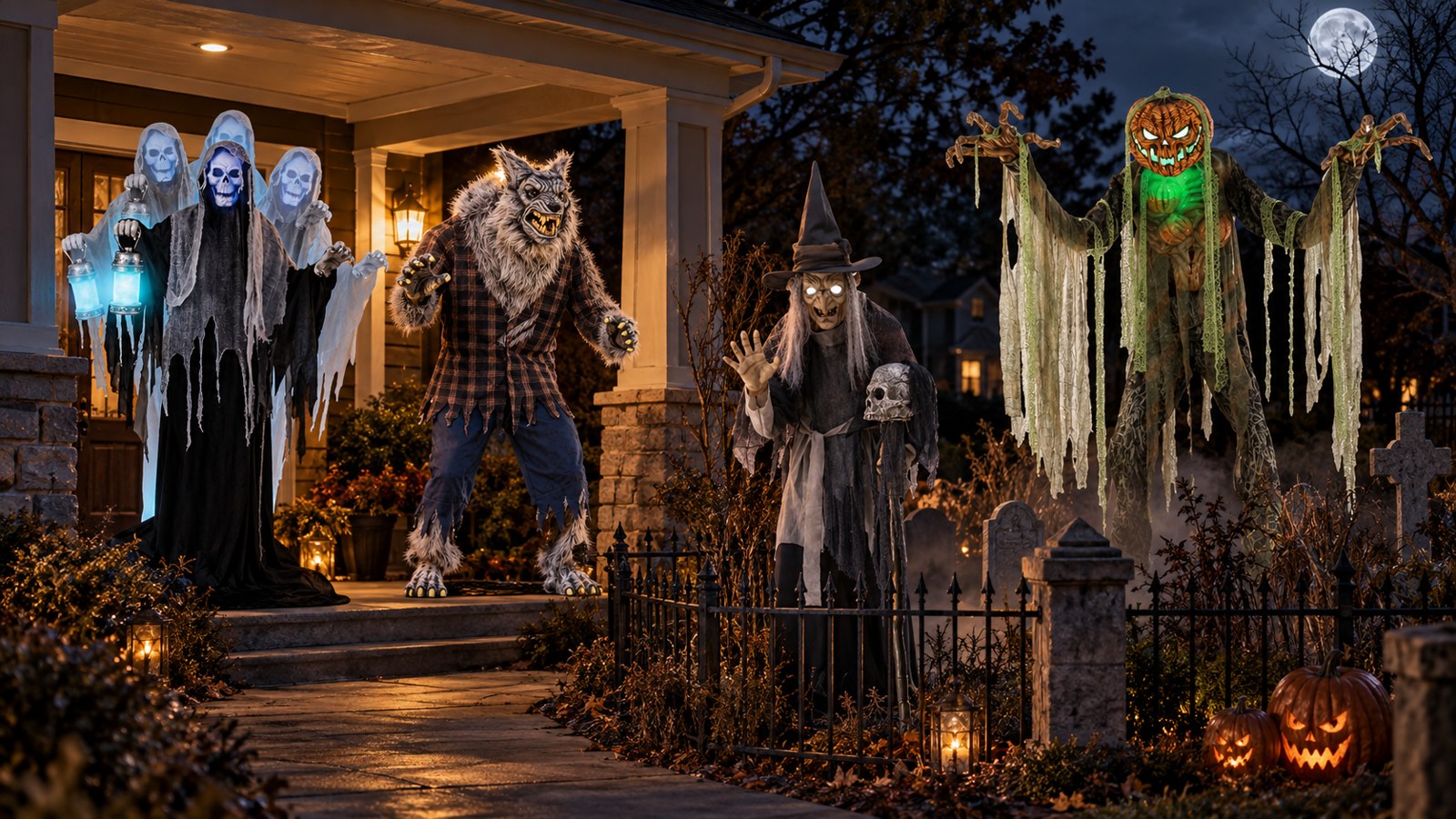
The biggest outdoor Halloween prop is not automatically the best one for your yard.
The short answer: before buying an outdoor animatronic, verify the exact weather-use language, assembled dimensions, moving clearance, power requirements, activation method, anchoring options, sound controls, setup time, and storage space. Pay especially close attention to the difference between outdoor, covered outdoor, and sheltered outdoor use. A prop described for covered outdoor use should not be treated as weatherproof or left exposed to rain.
A successful purchase fits the place where it will actually operate. That may be a roofed porch, a protected garage opening, a dry entryway, or a yard scene that can be brought inside when weather changes. Measure first. Plan the cable route. Then choose the character. Before ordering, set a total budget for your first animatronic that includes setup and storage.
Outdoor Animatronic Buying Checklist
| Check before ordering | Why it matters | What to confirm |
|---|---|---|
| Weather-use wording | “Covered outdoor” is not the same as weatherproof | Exact language on the product page and instructions |
| Assembled size | Listed height alone does not show the full footprint | Height, width, depth, and overhead clearance |
| Movement envelope | Arms, heads, torsos, and lunging parts need open space | Full reach in every direction while operating |
| Base and anchoring | Wind and uneven ground can destabilize tall props | Flat surface, tie-down plan, sheltered placement |
| Power | Adapters and connections need safe, dry routing | Outlet location, cord length, approved accessories |
| Activation | A sensor can miss guests or trigger constantly | Sensor range, direction, lighting, footpad option |
| Volume | Repeating dialogue can overwhelm a small porch | Volume control and acceptable operating hours |
| Assembly | A large prop may require more than one person | Frame design, instructions, setup and test time |
| Storage | Fabric, frames, electronics, and sculpted parts need protection | Dry off-season space and suitable containers |
| Guest clearance | A scare should never force people into the mechanism | Safe path, barriers, visibility, supervision |
1. Read the Weather Language Literally
Start with the product description and instructions, not the scene pictured in the marketing photo. A yard, porch, or graveyard setting shows how a prop can be staged; it does not by itself establish that the product can withstand open weather.
These terms are not interchangeable:
- Indoor use means the prop should stay inside.
- Sheltered outdoor use generally means it can operate outside only where a roof or enclosure protects it from direct rain and similar exposure.
- Covered outdoor use likewise calls for a protected location rather than an open lawn.
- Outdoor use may allow broader placement, but the instructions still control how the product should be powered, secured, stored, and protected.
- Weather-resistant does not mean waterproof.
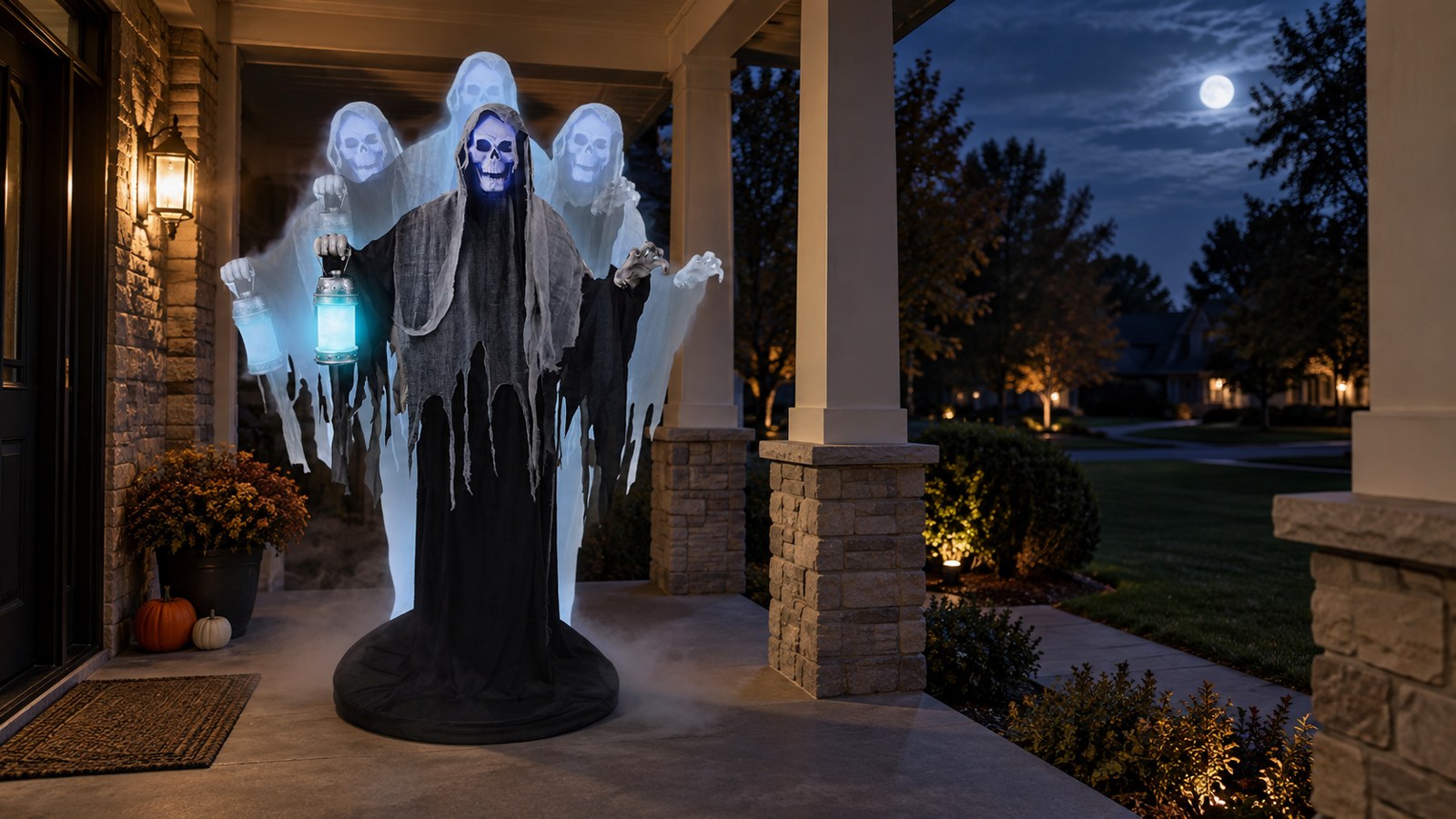
For example, The Horror Dome describes the Animated Rising Ghost Reaper for indoor or sheltered outdoor use. The 7.5-Foot Hulking Werewolf is listed for indoor or covered outdoor use. Both can make strong exterior displays, but neither description gives buyers a reason to leave the prop uncovered in rain.
If a page does not state an outdoor-use rating, do not infer one. Ask the seller or choose a more protected site. Electronics, fabric, hair, paint, connectors, speakers, and motors may all respond differently to moisture.
A simple rule helps: if the forecast changes, have a fast plan to switch off, unplug, and move the prop to a dry location. Do not wait until the first drops reach the adapter.
2. Measure the Prop’s Entire Operating Space
Height attracts attention, but width and depth decide whether the prop fits.
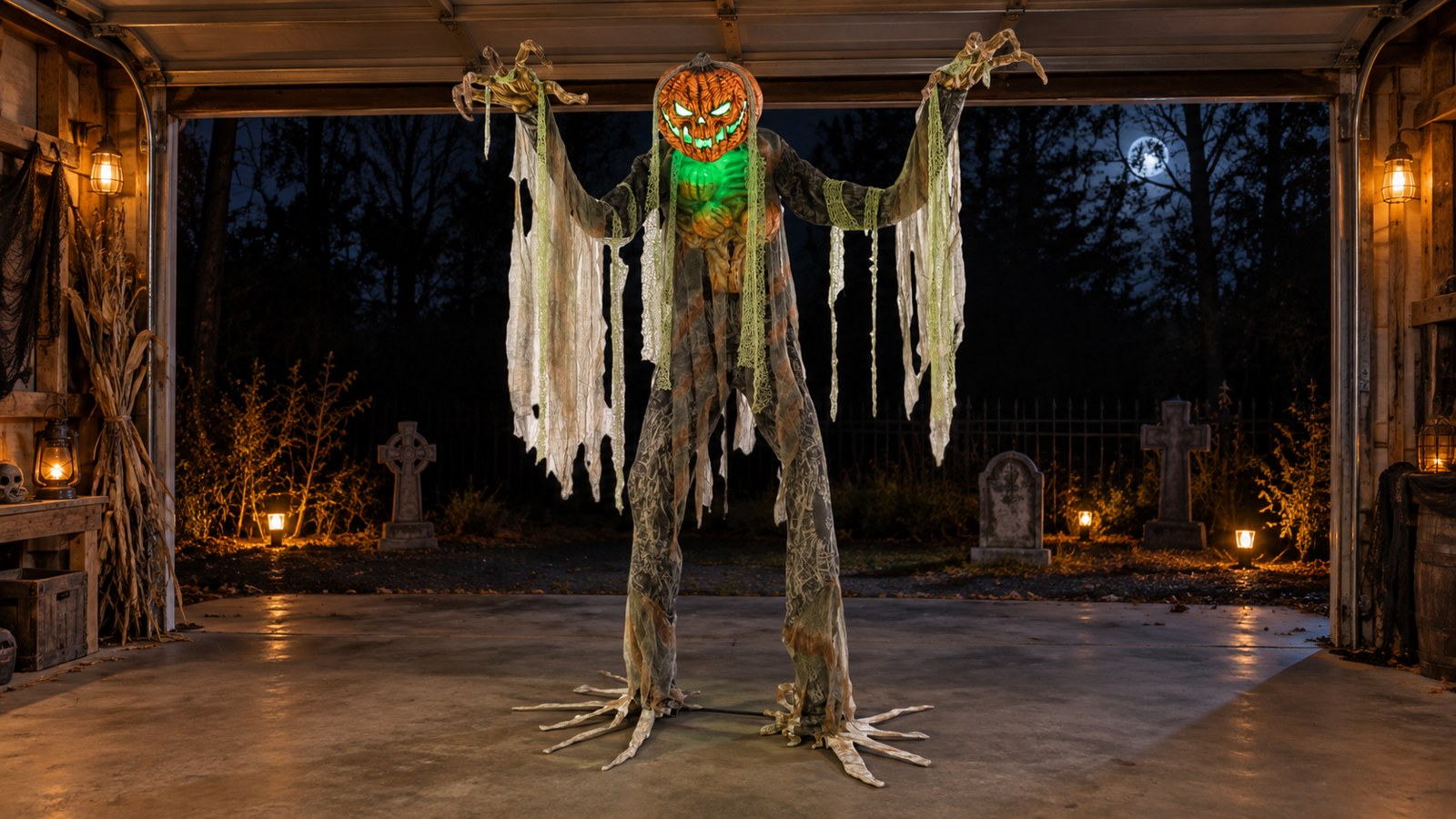
The Root of Evil Animated Halloween Prop is a useful example. It stands 83 inches high, but its listed assembled dimensions are also 66 inches wide and 60 inches deep. Its waist twists and its head turns. A buyer who plans only for a seven-foot ceiling may still discover that the character crowds the doorway, brushes a wall, or reaches into the guest path.
Measure four zones:
- Static footprint: the floor or ground occupied by the base and frame.
- Moving envelope: the farthest point reached by arms, clothing, head, staff, wings, or a lunging body.
- Guest buffer: extra space that keeps visitors outside the moving mechanism.
- Service access: enough room to reach the controls, adapter, fasteners, and frame without dismantling the scene.
Use painter’s tape, garden stakes, or small cones to mark the proposed footprint before ordering. Then walk the route as a guest would. Check the view from the street, sidewalk, driveway, porch steps, and doorway.
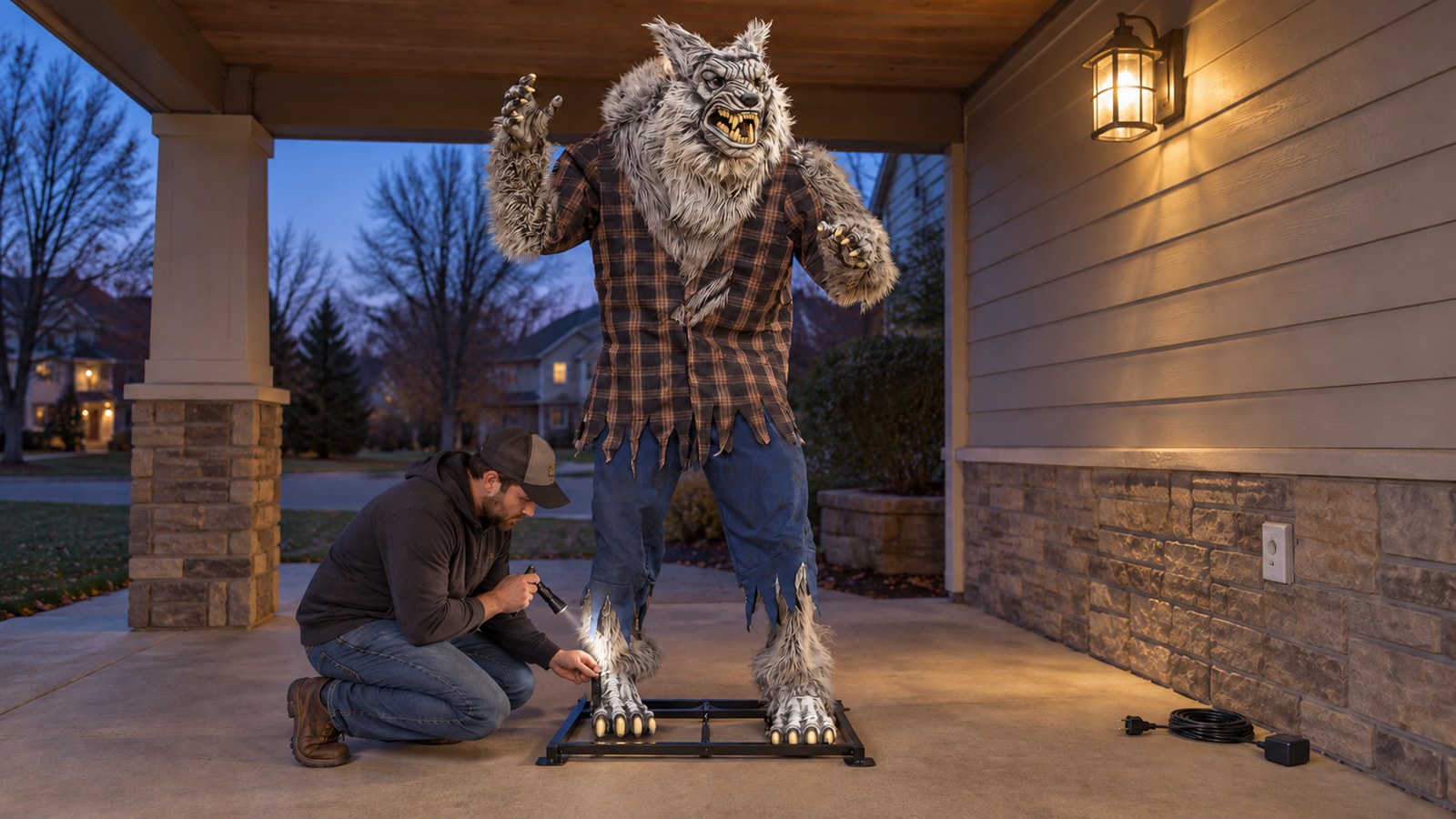
Do not forget vertical clearance. A 7.5-foot werewolf may fit under a nine-foot porch roof when standing still, yet raised arms, nearby lights, hanging decorations, or a sloped ceiling can reduce usable space. Measure the lowest obstruction, not the highest point of the roof.
3. Match the Motion to the Location
Different movements create different placement problems.
A slow rise can work near a graveyard scene. A head turn or waist twist needs side clearance. A swaying character needs a stable base and room for fabric. A lunge demands a generous no-guest zone in front of the prop.
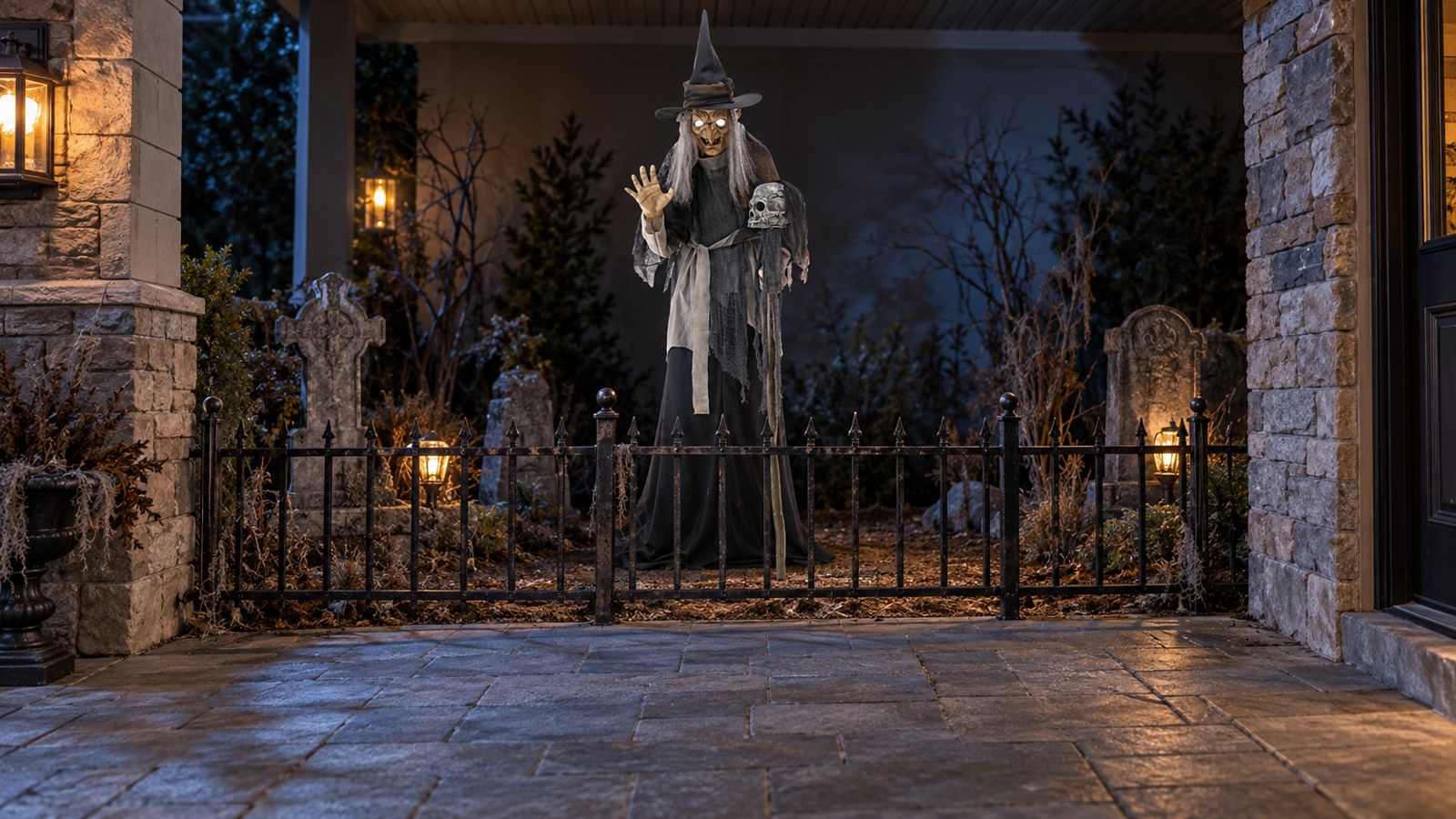
The Horror Dome’s Lunging Haggard Witch stands more than six feet tall and suddenly lunges forward when activated. That forward movement is the effect, so placing her tight against a narrow walkway would waste the scare and create a poor traffic pattern. Position a lunging prop behind a railing, low fence, planter line, or other visible boundary so guests cannot step into its reach.
Root of Evil uses a turning head and twisting waist instead of a forward lunge. That movement can suit a broad display bay, but it still needs lateral clearance and a flat, stable position.
Run every animatronic through several complete cycles before guests arrive. Watch the fabric and cables as closely as the character. A sleeve or robe that drifts into a joint can become a bigger problem than an arm near a wall.
4. Decide How the Scare Should Trigger
An animatronic is most effective when it activates at the intended moment—not when cars pass, tree branches move, or guests have already walked away.
Common activation choices include:
- Motion or infrared sensor: convenient for hands-free operation, but placement determines reliability.
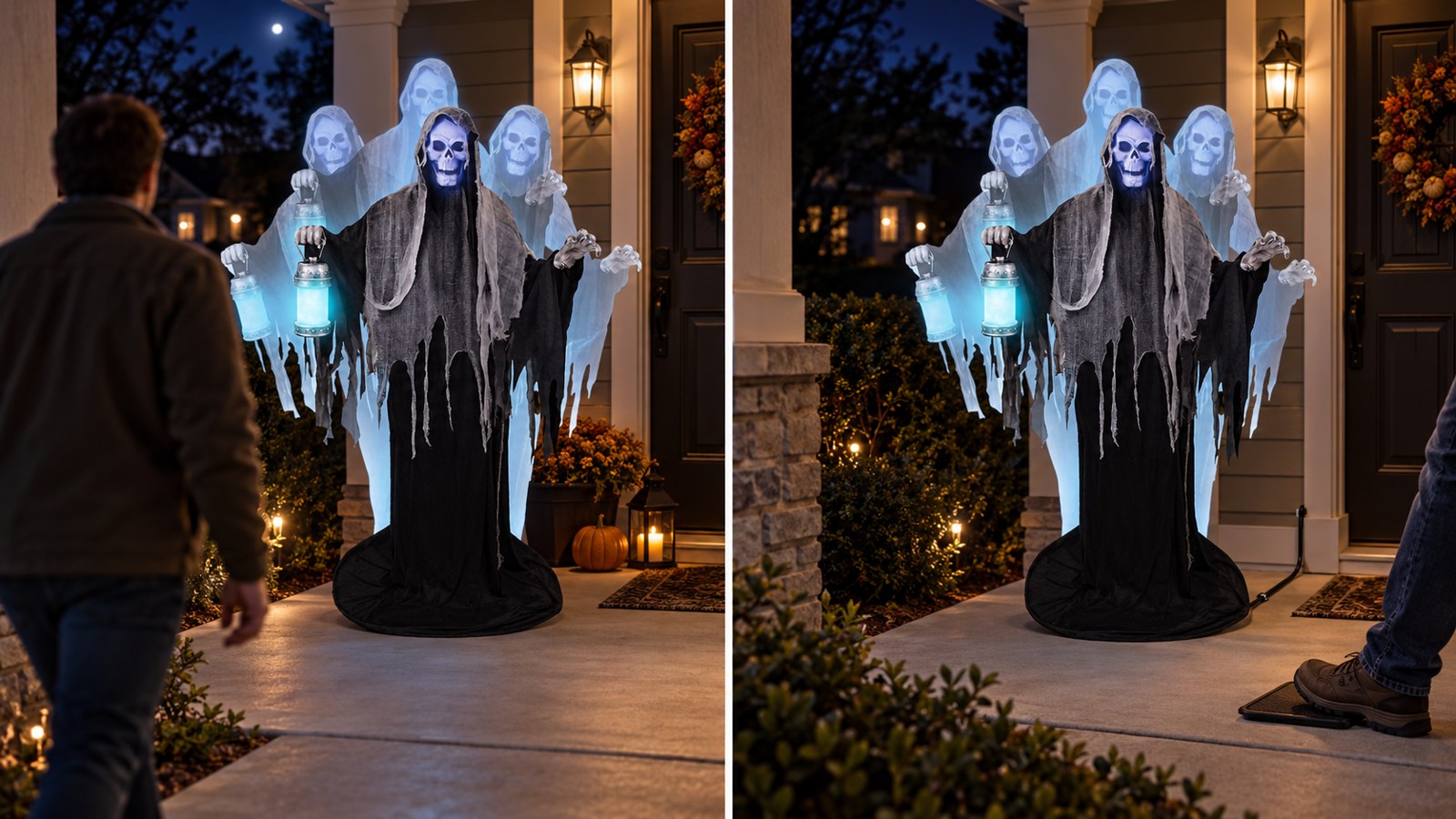
- Step pad: gives a deliberate trigger point and can help control timing.
- Steady-on mode: useful for continuous display or for testing, although constant motion and repeated audio may not suit every scene.
- Manual or remote control: common in more advanced attractions, but compatibility varies by product.
Root of Evil and Lunging Haggard Witch each list three modes: steady-on, infrared sensor, and an included step pad. Their product descriptions state that the infrared sensor works up to 6.5 feet away in any lighting condition. That gives you options, but it does not eliminate the need to test the final placement.
Aim the sensor across the natural approach instead of directly at a busy street. Keep moving foliage, reflective decorations, and other animated props from constantly crossing the detection area. If you use a step pad, keep its cable out of the walking path and do not create a trip hazard.
The right trigger depends on the scene. A sensor works well when guests reliably approach from one direction. A step pad is better when precise timing matters or when an actor can guide guests toward it. For a detailed comparison, see Motion Sensor vs. Step Pad: Which Animatronic Trigger Works Better?
5. Plan Power Before You Plan the Scare
Find out whether the prop uses batteries, an adapter, or either option. Then check what is included.
The Animated Rising Ghost Reaper can run on four AA batteries or an optional 6V 2A adapter; both are sold separately according to its current product page. Root of Evil and Lunging Haggard Witch list a UL power adapter that plugs into a standard outlet.
Those differences affect the total purchase and the placement. Battery power can simplify a protected scene where a cord would be awkward, but batteries require monitoring and replacement. Plug-in power may be better for consistent performance, yet the entire connection path must be planned safely.
Follow the manufacturer’s instructions and local electrical requirements. Use only suitable equipment for the environment, keep connections dry, avoid overloading circuits, and use ground-fault protection where required. Do not run a cord where guests can trip over it, where a door can crush it, or where landscaping equipment can damage it. If the safe setup is unclear, consult a qualified electrician.
Never assume that a covered prop makes an unprotected adapter or cord connection safe.
6. Give Tall Props a Wind and Stability Plan
Height creates leverage. A large head, wide arms, hanging cloth, or artificial hair can catch moving air like a sail.
Before buying, look at the base, frame, total width, weight, and any manufacturer-provided anchoring points or instructions. Plan for a level surface. Keep the animatronic away from stairs, traffic, open flames, heaters, and anything fragile that it could strike if shifted.
Do not improvise by fastening ties to moving arms, electrical cables, fabric, or weak decorative parts. Follow the supplied assembly and securing instructions. If the product does not provide a safe way to stabilize it in your location, move it to a more protected position.
Check the display every day before turning it on. Loose frame connections, softened ground, displaced ballast, snagged fabric, and changing wind can alter a setup that seemed solid the previous evening.
7. Check Sound Controls and Your Audience
Sound makes a moving prop easier to notice, but repetition becomes obvious quickly. On a compact porch, a loud phrase can overpower the entire display. In a quiet neighborhood, it may also travel farther than expected.
Look for volume control. The Rising Ghost Reaper, Root of Evil, and Lunging Haggard Witch all list adjustable volume. The Rising Ghost Reaper also includes an external speaker jack, which may help in a larger controlled display.
Test sound from the property line, not only while standing beside the prop. Set reasonable operating hours, especially on school nights. A lower voice coming from a dark, well-lit face can be more effective than maximum volume.
Also consider the age and comfort level of your visitors. A sudden lunge at full volume may be right for an adult haunt path and wrong for a front walk used by small children. Give guests a clear route past the effect, and keep an adult nearby when the display is operating.
8. Include Assembly, Testing, and Storage in the Purchase
The price on the page is only one part of ownership. Large animatronics require time and space.
Root of Evil and Lunging Haggard Witch use quick-connect metal frames. The Rising Ghost Reaper is described as requiring simple assembly with instructions included.
Build a new prop in daylight, preferably with another adult available for tall or awkward sections. Confirm that every connection is fully seated, then test all modes. Keep packaging and photograph the finished assembly before taking it apart. Those pictures can make next season’s setup much faster.
Storage matters just as much. Before ordering, answer these questions:
- Where will the frame, head, hands, costume, adapter, and activation pad stay after Halloween?
- Can the storage area remain dry and avoid extreme conditions?
- Will the sculpted face or hands be supported rather than crushed?
- Can small parts and instructions stay labeled with the prop?
- Is the box small enough to reach the attic, basement, closet, or shelving where it belongs?
A spectacular animatronic that cannot be stored safely may become a one-season purchase.
A Real-World Placement Example
Imagine a Lafayette home with an eight-foot-deep covered porch, a front walk that turns toward the steps, and an outlet beside the door.
The 7.5-foot Hulking Werewolf creates a powerful silhouette, but only if the roof and full arm movement leave enough clearance. It needs a stable, protected position and cannot block the door. The Rising Ghost Reaper is less expensive and offers battery operation, which may simplify cable management, but it still needs sheltered placement and a deliberate sensor angle.
Now consider the Lunging Haggard Witch. Her forward motion could produce the strongest jump scare, yet the porch depth alone does not make her the best choice. If the lunge reaches toward the only walking line, the effect needs a barrier and more guest buffer than the site may allow.
In that case, the best animatronic is not the one with the most dramatic motion. It is the one that stays dry, fits behind a clear boundary, activates as guests approach, and leaves the doorway usable.
Four Horror Dome Animatronics to Compare
These are not interchangeable recommendations. Each illustrates a different part of the buying decision.
| Product | Best reason to consider it | Important planning detail | Price when checked* |
|---|---|---|---|
| Animated Rising Ghost Reaper | Slow rising motion, illuminated face and lantern, battery or optional adapter power | Indoor or sheltered outdoor use; batteries and adapter sold separately | $159.99 |
| Root of Evil | Seven-foot scale, twisting waist, turning head, three activation modes | Needs a 66-by-60-inch area before adding guest clearance; confirm outdoor suitability before exterior use | $409.99 |
| Lunging Haggard Witch | More-than-six-foot character with a sudden forward jump scare | Requires a large no-guest zone in front; confirm outdoor suitability before exterior use | $374.99 |
| 7.5-Foot Hulking Werewolf | Towering scale, moving jaw, head, and arms, plug-in operation | Indoor or covered outdoor use; check roof, arm, and doorway clearance | $389.99 |
*Prices and availability were checked September 15, 2026 and may change during the Halloween season.
The Halloween Animatronics collection at The Horror Dome includes home-haunt and professional options across several character types. Use the collection to compare styles, then verify the individual product page and instructions before deciding where any animatronic can operate.
Questions to Ask Before Clicking “Add to Cart”
- Does the product explicitly allow outdoor, covered outdoor, or sheltered outdoor use?
- Can I protect it from direct rain and move it inside quickly?
- Have I measured height, width, depth, and the complete motion envelope?
- Can guests remain outside every moving part?
- Is the base suitable for my porch, pavement, garage, or ground surface?
- How will I stabilize it according to the instructions?
- Does it use batteries, an included adapter, or a separately sold adapter?
- Can I route and protect power without creating a trip or moisture hazard?
- Will the sensor see guests at the correct moment?
- Would a step pad give me better control?
- Can I adjust or disable the sound if needed?
- Do I have time to assemble and test it before the event?
- Do I have dry storage space for every component?
- Is the return policy acceptable if the scale or fit is wrong?
If any answer is uncertain, pause the purchase and verify it. Ten minutes of checking can prevent an expensive prop from ending up in a place where it cannot be used safely.
Final Verdict
Buy an outdoor animatronic for the site you have, not the scene you wish you had.
First confirm the weather-use language. Then measure the prop at full size and full movement. Plan a stable base, dry power, reliable activation, sensible sound, guest clearance, assembly time, and off-season storage. Character design comes after those practical checks.
For a protected porch with limited wiring, the battery-capable Rising Ghost Reaper may be a practical starting point. For a tall covered display with generous clearance, the Hulking Werewolf offers major visual presence. A lunging witch or twisting seven-foot scarecrow can produce a sharper scare, but only where the movement envelope and guest boundary support it.
The best outdoor animatronic is the one that performs reliably in its actual location—and can be brought back in good condition next Halloween.
Frequently Asked Questions
Can Halloween animatronics stay outside in the rain?
Do not assume they can. Follow the exact product description and instructions. A prop listed for covered or sheltered outdoor use should be protected from direct rain, and its power connections must also remain safe and dry.
What does “covered outdoor use” mean for an animatronic?
It generally means using the prop outside only in a protected area, such as a roofed porch, where it is not directly exposed to precipitation. It does not mean waterproof. Follow the product’s instructions and contact the seller if the intended location is unclear.
How do you secure a tall Halloween animatronic outside?
Place it on a level surface and use only the securing or anchoring methods allowed by the manufacturer. Keep it away from guest paths and move it inside when conditions exceed what the instructions permit. Never attach restraints to moving or fragile parts.
How much space does an animatronic need?
Allow space for the static footprint, the farthest reach of every moving part, a guest safety buffer, and access to the controls. Use the fully assembled height, width, and depth rather than height alone.
Is a motion sensor or step pad better outdoors?
A motion sensor is convenient when guests approach from a predictable direction. A step pad provides more deliberate timing and may avoid unwanted triggers. The better choice depends on traffic, placement, cable routing, and the type of scare.
Can I use an extension cord with a Halloween animatronic?
Use only power equipment appropriate for the location and permitted by the manufacturer and local requirements. Keep all connections dry, use ground-fault protection where required, and prevent trip, pinch, and damage hazards. Consult a qualified electrician when uncertain.
When should I buy an outdoor animatronic before Halloween?
Buy early enough to inspect, assemble, test, and exchange it if necessary. September gives many home haunters more time than a late-October purchase, while popular products and shipping options may become more limited as Halloween approaches.