
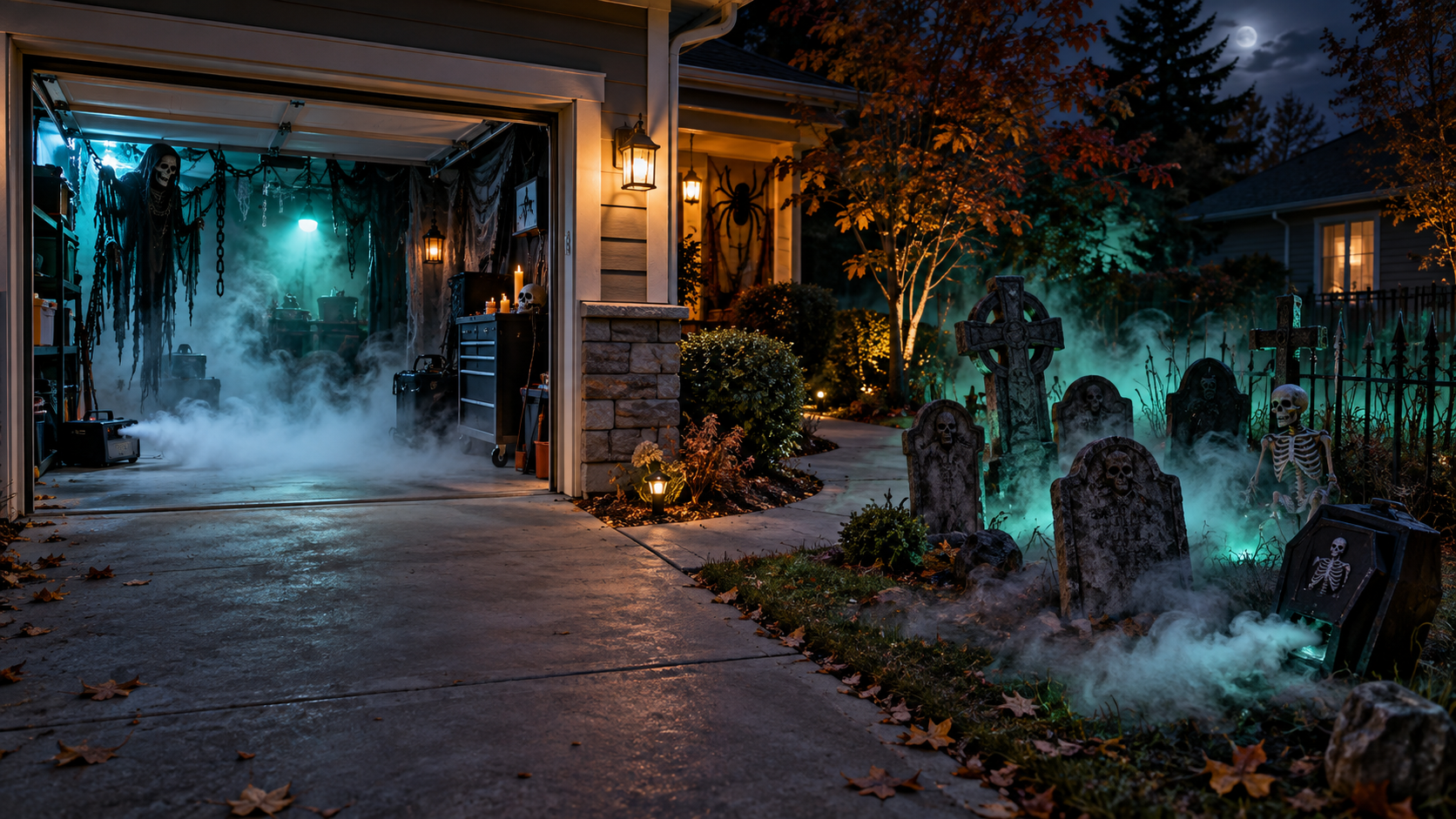
The short answer: start with a 400W fog machine for a porch, small indoor scene, or compact single-car garage. Choose a 1000W machine for a two-car garage, a longer walkthrough, or a sheltered section of your yard. For a wide or windy yard, one larger machine may still be less effective than two well-placed machines.
Wattage is useful, but it is not a perfect measure of fog coverage. It mainly tells you how powerful the heater is. Actual results also depend on the machine’s output, warm-up and recovery time, the fog fluid, the shape of the space, temperature, and—outdoors—the wind.
That last factor ruins more Halloween fog effects than an underpowered machine ever will. A thick cloud that fills a garage can disappear across an open lawn in seconds.
Quick Fog Machine Size Guide
| Your setup | Good starting point | Why |
|---|---|---|
| Porch, photo area, or one small scene | 400W | Enough for short bursts in a controlled area |
| Compact single-car garage | 400W–1000W | Choose based on how dense and continuous you want the fog |
| Two-car garage or short walkthrough | About 1000W | Faster output and better recovery for repeated groups |
| Sheltered graveyard or small yard scene | About 1000W | More output helps replace fog lost outdoors |
| Wide, exposed, or windy front yard | Two machines or multiple fog points | Placement and distribution matter more than one big blast |
| Ground-hugging cemetery or swamp | Low-lying fog machine | Designed for a different visual effect than ordinary airborne fog |
These are practical starting points, not guarantees. Test your exact layout before Halloween night. A calm, fenced yard behaves very differently from an open driveway with a steady crosswind.
Why Fog Machine Wattage Does Not Tell the Whole Story
When shoppers compare fog machines, wattage is usually the first number they see. A 1000W machine sounds as if it should cover two and a half times as much space as a 400W model, but fog does not behave that neatly.
Look at five things together:
- Heater wattage: A higher-wattage heater usually supports stronger output and quicker recovery.
- Output rating: When the manufacturer provides cubic feet per minute, this is a more direct indication of how much fog the machine can produce.
- Duty cycle: Small foggers often pause to reheat. That matters in a walkthrough with groups arriving every minute.
- Controls: A timer or remote makes it easier to use short, repeatable bursts instead of flooding the entire scene.
- Air movement: Fans, open garage doors, outdoor wind, and even guests moving through a narrow passage can push fog away from the scare.
The goal is not to fill every cubic foot with fog. The goal is to put enough fog in the right place so lighting, props, and actors look better.
Is a 400W Fog Machine Big Enough?
A 400W fog machine is a sensible entry point for a porch, party room, photo setup, or small garage display. It is especially useful when you want occasional atmosphere rather than a nonstop wall of fog.
The Horror Dome’s 400W Fog Machine includes a wired remote and produces fog in four-minute intervals. Fog fluid is sold separately. In a controlled space, that is enough to soften the background, reveal colored light beams, or hide the base of a prop.
A 400W machine makes the most sense when:
- Your scene is compact and partially enclosed.
- You can place the machine close to the effect.
- You only need short bursts.
- Guests move through slowly or view the display from one direction.
- You are willing to let the machine recover between cycles.
It may feel underpowered if the garage door stays fully open, guests arrive in rapid groups, or you are trying to cover a large portion of the yard. Do not solve that problem by holding the remote down until nobody can see. Either tighten the scene, improve placement, or move up in output.
When Should You Choose a 1000W Fog Machine?
A 1000W machine is a better starting point when you need a stronger burst, quicker replenishment, or coverage across a larger controlled area. Think two-car garage, short haunted walkthrough, sheltered graveyard, or a central outdoor scene built near a fence or wall.
The Fog Machine Skeleton 1000W from The Horror Dome is rated at 3,000 cubic feet per minute, includes a wired remote, and has a listed warm-up time of three to five minutes. Fog fluid is not included. The coffin-shaped housing and skeleton design also make it easier to leave the unit visible inside a Halloween display.
Choose a 1000W fogger when:
- A 400W machine cannot rebuild the atmosphere between guest groups.
- Your display spans a two-car garage or several connected scenes.
- The fog must travel farther before it reaches the reveal.
- You want one strong burst timed to an actor, animatronic, or lighting cue.
- You are using fog outdoors in a protected area where mild air movement is unavoidable.
More power is not permission to use more fog than the scene needs. A short pulse across a backlit doorway can look enormous. A long blast into a dark room can hide the very monster you paid to show people.
What Size Fog Machine Works Best in a Garage?
For most home garage haunts, the choice comes down to how the garage is being used.
Single scene in a one-car garage
Start with 400W. Aim across the scene—not toward guests—and let the fog catch side light or backlight. If the main door remains open, place the machine deeper inside so the fog has time to spread before drifting out.
Walkthrough in a one- or two-car garage
Move toward 1000W if groups will enter repeatedly. Recovery time becomes more important than raw room size. You need the effect to look intentional for the fifth group, not only the first.
Garage with multiple rooms or wall panels
One machine at the entrance may not distribute fog through every turn. A compact machine near each major scene can provide more control than one large fogger trying to push through the entire layout.
For the full build—including guest flow, cable placement, ventilation, and sightlines—link this section to How to Make a Haunted House in Your Garage or Backyard on Haunting News.
What Size Fog Machine Works Best in a Yard?
Outdoors, stop thinking about the total square footage of your property. Define the part of the yard that actually needs fog.
A graveyard vignette measuring 10 by 15 feet may only need fog around the tombstones. A creature reveal may only need a burst behind a tree. A walkway may need several small fog entry points instead of one machine beside the porch.
For a sheltered yard scene, a 1000W machine is a useful starting point. For a broad open lawn, plan around wind before buying more wattage.
Use fences, hedges, walls, tombstones, and scenery to slow the fog. Position the nozzle so the prevailing breeze carries the effect into the scene. If the breeze carries it toward the street, turn the layout around or move the machine—not just the output dial.
In a wide display, two machines placed at opposite ends can create more even atmosphere than one giant cloud in the middle. They also let you trigger fog only where guests are looking.
Do You Need a Standard or Low-Lying Fog Machine?
A standard fog machine throws a cloud that spreads through the air. It is useful for revealing light beams, creating a sudden burst, or adding depth to a room.
A low-lying fog machine is intended to keep the effect closer to the ground. That makes it the better visual choice for cemeteries, swamps, crypt floors, and scenes where the fog should roll around feet and tombstones.
The Horror Dome’s Low-Lying Fog Machine can be triggered remotely and requires Ground Fogger low-lying fog fluid, sold separately.
Low-lying fog is not automatically the right choice for every yard. Warm pavement, wind, and foot traffic can lift or break up the effect. If your goal is simply to make green or blue lighting visible in the air, a standard fogger may be the simpler tool.
For a deeper guide to keeping fog near the floor, link this section to Low-Lying Fog and Atmosphere on Haunting News.
Controls Can Matter as Much as Size
The difference between amateur-looking fog and a convincing atmosphere is often timing.
A manual remote works well when someone can watch the scene and trigger a burst before guests arrive. A timer is better when the haunt runs continuously and no one can babysit the fogger.
The Horror Dome’s Fog Machine Timer supports duration, interval, continuous, and manual operation. Compatibility should be confirmed with the fog machine before purchase.
Start with shorter bursts and longer gaps. Watch where the fog travels, then adjust. You want layers of atmosphere with visible pathways—not a whiteout.
If you are building for a full season rather than one night, The Horror Dome also sells a 1000W Fog Machine Combo Package with six gallons of fog juice, a timer, and cleaning fluid.
How to Test Your Fog Machine Before Halloween
Run a full test at the same time of night your haunt will operate. Temperature and airflow can change after sunset.
Use this sequence:
- Put every prop, wall, light, and fan in its final position.
- Mark the path guests must be able to see.
- Warm up the fog machine according to its instructions.
- Trigger one short burst and time how long the useful effect remains.
- Watch the fog from the guest’s eye level—not from beside the machine.
- Adjust direction and placement before increasing duration.
- Repeat the test with the garage door open or in the actual outdoor breeze.
- Walk the route and confirm that steps, cables, exits, and low obstacles remain visible.
Test nearby alarms and review local or venue rules before using theatrical fog indoors. Never disable a safety system to make an effect work. Keep the unit dry, stable, and separated from fabrics, walls, faces, and other surfaces by the clearance required in its manual. Use only compatible fog fluid.
Fog Machine Buying Checklist
Before ordering, answer these questions:
- Is the scene indoors, sheltered, or fully exposed?
- How large is the specific effect area—not the entire property?
- Do you need airborne fog or ground-hugging fog?
- How often will groups enter the scene?
- Will someone trigger the machine, or do you need a timer?
- Where will the fog travel when the garage door opens or the wind blows?
- Can guests still see the path and exits?
- Does the machine include a remote and fluid?
- What fluid does the manufacturer specify?
- How will you clean and store the machine after the season?
You can compare current machines, fluids, remotes, and accessories in The Horror Dome’s Fog Machines collection.
The Bottom Line
For a small porch, room, or compact garage scene, a 400W fog machine is usually the right place to start. For a two-car garage, repeated walkthrough traffic, or a sheltered yard scene, step up to roughly 1000W. For a wide or windy yard, improve placement and consider multiple fog points before assuming one higher-wattage machine will solve everything.
Buy for the effect, not the property line. A precise ribbon of fog behind a tombstone is scarier than a whole yard buried under a cloud nobody can see through.
Frequently Asked Questions
How many watts should a fog machine be for Halloween?
For a small, controlled Halloween scene, start around 400W. For a two-car garage, short walkthrough, or sheltered yard display, about 1000W is a stronger starting point. Outdoor wind, output rating, recovery time, and placement can matter more than wattage alone.
Is a 400W fog machine enough for a garage?
It can be enough for a compact single-car garage or one focused scene, especially when the door is partly closed and you only need short bursts. A larger or busier garage haunt may benefit from a 1000W machine or more than one fog point.
Will a 1000W fog machine work outdoors?
Yes, but results depend heavily on wind. A 1000W machine can work well in a sheltered yard, near a fence, or inside a concentrated graveyard scene. An open, breezy lawn may need better placement or multiple machines.
Is a low-lying fog machine better for a graveyard?
Usually. Low-lying fog is designed to remain closer to the ground, making it a strong choice for tombstones, swamps, crypts, and cemetery paths. Weather and warm ground can still cause the fog to rise or disperse.
Can a fog machine set off a smoke alarm?
Yes. Theatrical fog can activate some smoke-detection systems. Test the setup in advance, follow venue and local rules, and never disable a fire alarm or other safety system for a Halloween effect.
How do I keep outdoor fog from blowing away?
Use scenery, fences, walls, or hedges as windbreaks; place the machine upwind of the effect; and keep the fog close to the scene. On a windy night, multiple short-range fog points usually work better than one long blast.